
Is melodrama hereditary? I know that most likely it’s learned behavior, but I feel like I inherited mine. It wasn’t one of my mother’s most prevalent characteristics, but it was always there. In most dramatic fashion, she ripped a nightgown off in the middle of the living room after I projectile vomited as an infant all over her and no one was helping her (she told me this story herself). When working extra jobs to get her beau a special collection of books for Christmas, he accused her of neglecting her children by leaving them home alone for several hours late in the evenings. She threw each one of those books at him while explaining what she was doing. I really don’t want to tell you that it was my daddy – but it was. A sibling told me this story that happened before I was born. Those are just two of my favorite recollections of melodramatic Mommy.
When my melodramatic self shows up to the party, I fully embrace her. I can remember falling on the floor in swoon-worthy fashion when hearing something that pushed me to my limits – annoyances or shocking statements. I took preliminary results of my first mammogram (“we see something on the mammogram that we want to look at more closely”) and ran the entire gamut of having breast cancer and requiring surgery and which fundraising marches I would participate. Just a few weeks later – and several months of monitoring – the true results were I have a benign cyst that doesn’t even need to be removed. I can tell an inflated recounting of a situation that impresses myself, and sometimes I have to let witnesses know that I am reveling in my most melodramatic self when they begin to wonder if I was even present in the same event. I’ve thrown some things in anger – fortunately not at anyone – and I’ve slammed a landline phone down seven times after an irritating conversation. And honestly, I’m very pleased with my melodramatic self. I find her completely entertaining.
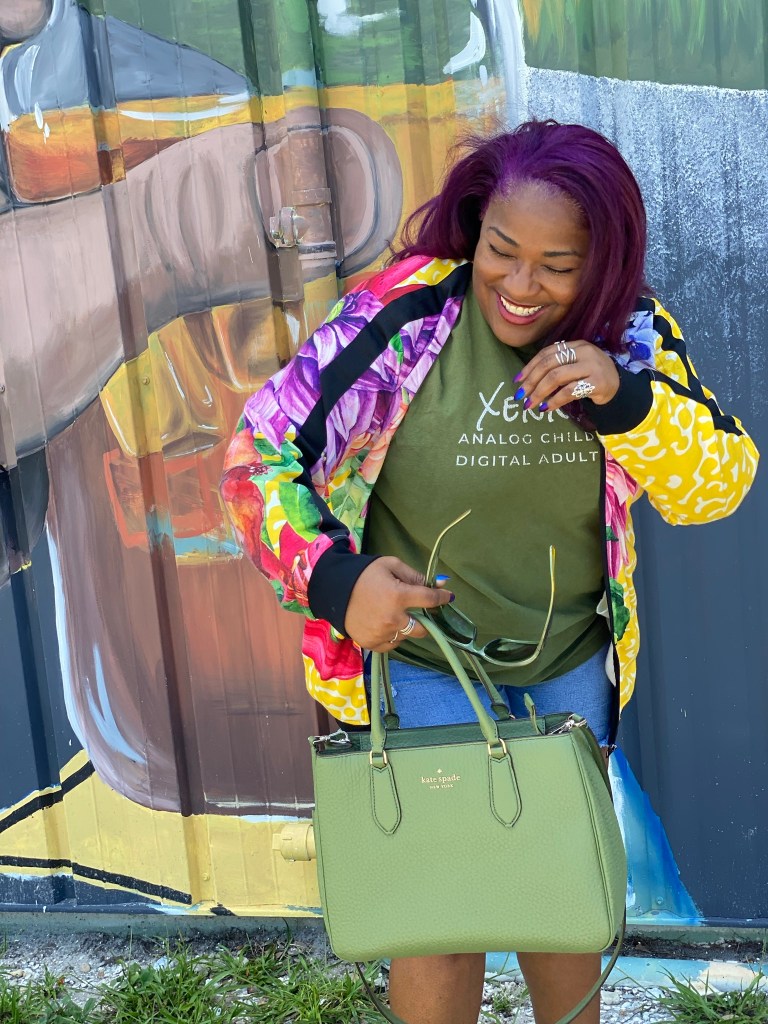
I am Regina Lynette. I love myself when I’m being the most. Like when I wear all the colors, and dye my hair purple, and wear purple nails, and wear all my rings at the same time, and wear a graphic tee with an identity statement, and choose green because it enhances creativity, and stand beside a giant mural of a mason jar of sweet tea.
Even though I have moments where I am being the most and truly loving the fact that I am being the most, I have moments on the complete opposite side of the spectrum. And the moments where I believe I am not enough or the moments where I intentionally try to be less might also be hereditary or maybe learned behaviors. Both of my parents had certain insecurities, but I spent much more time talking to my father about the moments where he was a victim of believing he was not enough. For my father his insecurities stemmed from a good desire to better himself. Unfortunately, he was embarrassed about his lack of formal education and some elements of his upbringing. When people made assumptions like his attending seminary and having a post-graduate degree, he would shrink in silence – never misleading anyone but seldom if ever correcting them. He lived with a level of embarrassment from only completing the 7th grade. In his 60s he went to night school and got his GED, increasing his impression of his self-worth, but he still struggled with the fact that he was self-educated enough to appear more on the outside while believing he was less on the inside. This story about his education was something I was particularly proud of – I mean what he achieved in self-education in the absence of formal education, but I kept his secret until after he died.
My lesser self withdraws and hides in hopes that I won’t attract the attention of anyone or encourage any kind of interactions that would expose the ways I believe I’m not enough. I don’t believe I am as beautiful as other women in my family, so I purposely avoid dressing up and making up and other primping believing there is not enough in all the world to make me shine as brightly as they. And if I get a compliment, I believe it’s just a courtesy and insincere. I shrink whenever someone boasts that I know a lot about a subject or have great interest in something – I don’t want anyone to be disappointed at any level of ignorance I have about a particular subject. I’ve been so quiet and still in a room that once a person actually turned out the lights on me after checking that the room was empty – they quite literally did not see me sitting in the middle of the room. It’s like I have an invisibility cloak like a superhero except I only use it to avoid interactions with other people. While I consider this trait a negative, I still value it almost as much as my most melodramatic self. What I like about it is I can observe human behavior in a way to see intentions without being noticed and subsequently I can detect ill intentions or ingenuine people without being swayed by their tactics.

I am Regina Lynette. I love myself even when I think I’m not quite enough – when I keep my hair tied down so it doesn’t move, and I wear a cover-up with a full shorts ensemble underneath instead of daring to wear a swimsuit, and I wear sunglasses so dark you can’t see my eyes, and I sit on the back of a boat in silence while everyone else swims, and I decline any refreshment because I don’t want to demonstrate a need for anything.
Of course, the best of me can be found somewhere in the middle. My balanced melodramatic self is hilarious with impeccable comedic timing – a deadpan humor or a retelling of a story that will keep you entertained at worst and in stitches at best – and makes heavy life situations lighter and easier to maneuver. My balanced lesser self is humble and creates a very calm, safe space where a person can be vulnerable and find peace. And I love my most balanced self just as much as the extremes.
I am Regina Lynette. I love myself when I’m being the most. And then again when I’m not enough.
“I love myself when I am laughing. . . and then again when I am looking mean and impressive.”
— Zora Neale Hurston

 I am Regina Lynette