5 Min Read, Mental Health

I love my therapist.

I am a black American Christian woman who believes in having a full-on mental health team. I also know that while I am not the only one, I know that it’s not exactly commonplace yet for my demographic. Since I began my mental health journey in college, I have kept my path pretty quiet, sharing information only with people I deemed either safe spaces or emergency contacts. But I think the time has come to say more and say it publicly. This is another reason I decided to do this blog in this manner. Part of who I am includes details about my mental health journey. But you not gonna get the juicy stuff today. Today, I celebrate my current therapist.

I am a black American Christian woman who has a white American woman in charge of her *talk-therapy. And I love my therapist. This year, while watching horrific news about white people killing black people, I found myself in a mental state about racism I’d never been in before. I simply didn’t want to talk to white people about anything and I didn’t want white people to talk to me about anything, simply because they were white people. I didn’t want apologies. I didn’t want questions. I didn’t want greetings or terms of endearment. I turned my nose up at the idea that a white person had words to say. And about a week before my next therapy appointment – the one that came after I realized my sensitivities to white people just because they were white – I needed to decide how I was going to talk to my white therapist. Other than the awareness of her being a white person, I didn’t feel the same animosity or angst about talking to this particular white person and I tried to unpack that some before my session. I didn’t do a great job.

My therapist has an artistic background, has lived in other countries, and has lived in large American cities known for diversity as well as smaller southern cities known for lack of diversity and that was enough to remind me that she was a safe space. During that session I told her that I do not want to talk to white people. She paused the session to make sure she understood what I was saying – because she’s a white person and I was talking to her. Then I tried to say I still felt she was a safe person despite my current feelings about white people and hoped I wasn’t offensive. A few weeks later she reached out to me to ask if I’d heard about a therapeutic product made specifically for people of color designed by an African-American therapist.  I thanked her for seeing my color. This was summer 2020. She is still my therapist and I still love my therapist.

That anecdote says nothing about how I’ve come to love my therapist, nor does it specifically promote therapy. But that anecdote is the demonstration that a therapist to love is a therapist who is right for you and your needs. A therapist to love is one who can handle what life throws you both and can still guide you through those challenging times. A therapist to love is one who sees you clearly and respects you completely. And my therapist is a therapist to love.

When I met this therapist, I was having complications and my chronic mental illness was out of remission leaving me unstable. She was referred to me by my psychiatrist along with a nutritionist. Having had therapy for more than 20 years, I had long developed a process to make sure I got the most out of my sessions. This included self-awareness of issues that surfaced, recognition of things that just weren’t working, and an acknowledgement of the level of disfunction my illness caused versus the level of disfunction my unresolved issues caused (which means I had to accept that sometimes I needed a pill and not only behavior changes).

There were a couple of problems immediately apparent to me in the first few sessions with this therapist. First, I wasn’t going to be in control of this process in the way I had been with previous therapists. Second, I didn’t have the energy, courage, nor foresight to take the reins of this process in the way I had done with previous therapists. Bumping up against that those first few sessions made me reconsider being under her care. I always had an introductory session or consultation before choosing a therapist and could establish my needs at that time. I just made an appointment with this therapist based on my chosen psychiatrist’s referral. But I decided to continue because in this case, my psychiatrist, talk-therapist, and nutritionist – my mental health team – all knew each other and could discuss my progress together and I wanted to see the benefits of that arrangement. So, I decided to “let go” (which ended up being the focus for at least a year) and stopped planning for my sessions. I would just show up and follow her lead. I found that the sessions where I had absolutely nothing planned to discuss were the best sessions. We were still getting to know each other, and I wasn’t really giving her much to work with – I wasn’t showing up and presenting myself to her in the sessions but was open enough to let her sort of rummage around and see what we could work on. And in time, she got to know me. She got to know the characters in my life. She knew when to pause a long time because she could see me thinking. She learned when to either re-direct or end the session because it was just too much to handle. And she learned how to check in with me at the start of each session to see how to best direct our time. Now she has a better handle on me than I have on myself in some ways and I trust her with my everything. That’s a therapist to love. And I love my therapist.

Only you know what you need from a therapist and only you know what’s most important to you in a therapist. However, when I am asked about what I’ve learned I need from a therapist and what’s important to me in a therapist, there is one thing that I consistently note first – the best professionals are artists. Creatives approach medicine with the idea that every human is different and that every human may respond differently to therapy – both techniques and medications. They understand that the patient knows more about their body and mind than anyone else and therefore require that a partnership be forged to determine a treatment plan (you’ll see this in the agreements in your intake paperwork or it will be discussed during your consultation and/or first appointment). Artists use their passionate natures to fuel their progress. And the patients of creative and artistic medical professionals benefit from getting a partner who holds their hand along the very customized treatment plan to reach the pinnacle of the individual’s health. They lay out a plan based on their education and experience and then stand back and look with admiration and pride at the mixed bag of tricks that the plan actually incorporates as it’s executed. My first artistic doctor beamed with pride with every success I had – we had. He fought to the death my insurance companies and got pissed at the pharmaceutical companies when they caused problems with getting my prescriptions filled. He was very invested in me and taught me to be very invested in my health.

I just wanted to tell the world that I love my therapist. And I know that it is critical that African-Americans seek therapy, and that African-American issues can often only be understood well by African-American therapists – so much so that I want to acknowledge it as fact. And I’ve had both black and white therapists and had positive experiences with both. Have the courage to seek the right therapist for you whether it’s gender, race, color, or any other identifiers and experiences.

I love my therapist.

*I use the term talk-therapy to refer to the sessions provided by my medical professional that rely mostly on talking. There are many different kinds of health professionals who take on this role so I use a broader term to focus on the process rather than the person’s credentials. When I use this term, usually I am separating doctors who prescribe medications from other medical health professionals who focus on a myriad of other techniques.


5 Min Read, Bookish, Social Media Handles

I am Regina Lynette, Tsundoku Sensei.

When I was a baby I fell off a bed head first into a bookcase with glass doors. The glass shattered and a shard of glass was stuck in my right eyelid. I needed stitches and it left a scar that moved, as I grew, a little higher on my eyelid, just under my eyebrow. Since I’ve had it for so long I never see it. But as people get to know me, in time they ask about the scar. When they ask, I always subconsciously search for it with my hands or look for it in a mirror, and then tell the short version of the story quickly because it all sounds horrific.

I suspect it was an early sign that I would be bookish – I needed to be with the books so desperately that I dove right into a full bookcase.

I remember reading for pleasure in the summers while in grammar school, almost always while laying on the bed under a ceiling fan and eating a granny smith apple. As life changed and I grew up, reading became a pleasure for my screened porch and my special strawberry lemonade. When it was difficult to maintain a quiet reading space, I made a reading soundtrack (curated on Apple Music and Spotify if you’re curious) and reading then became what I did in between loading and unloading the machines for weekend cleaning (washer, dishwasher, etc.). I bought fashion handbags based on whether or not they could hold a book and became a shuttle bus commute reader. I got the very first Nook for Christmas. And about eight years ago the unimaginable happened – I found it difficult to read anything at all. I just didn’t even know who I had become.

After years of having a bookshelf filled with books I’d already read, my accumulating stack of new books to be read was unfamiliar and uncomfortable. For a while I continued to buy new books because I believed that when my desire to read returned, it would be wonderful to just pull a new book off the shelf at home and read them all back to back without searching for a new read at the store. But then I stopped buying books because I wasn’t reading them, and it felt like a waste of money. Not buying books felt like giving up on my life. It sounds a bit dramatic, but it is honest. So I thought maybe I should become a book collector. But I didn’t become an avid book collector of pristine first editions and other valuable books nor did I have much interest in carefully preserving the books in my collection. Books are meant to be treated with respect, but they should look loved and that means some of them have battle scars. Spine creases are like laugh lines – little wrinkles that come from repeat happiness. Handwritten treasures, worn covers, and doodles all add to a book’s value to me.

Several years ago I received a book that had been sort of re-gifted – it was a book on grief and was given to me when my father died by someone who had received it when her father died. There was a note inside from the person who gave it to her, and she added a note for me. Then when someone I knew lost her father, I wrote a little note inside and passed it on to her. I just imagine this book being passed around the world forever and having all those little notes inside make the book more valuable in my eyes.

When I first heard the term Tsundoku Sensei, I added it to my list of social media bio identifiers. A Tsundoku Sensei is a master at collecting books whether or not they will be read. Because that’s what I’ve been doing, collecting books regardless of whether or not I will ever read them. I ‘tsundoku’ for a variety of reasons. If you identify with the list below, you might be a Tsundoku Sensei, too.

I began collecting copies of the same book. I read The Alchemist by Paulo Coelho at the end of every year so I buy a new copy every December. Whenever I see a copy of The Color Purple by Alice Walker or Their Eyes Were Watching God by Zora Neale Hurston that has a cover I don’t already own, I buy it. And I have a few copies of books in different formats – e-book, audiobook, paperback and hardback – just because I changed my mind about the format I wanted or because of needing a physical book or new book for a book signing.

I started buying books by recommended authors. Since I haven’t been reading a lot of books lately, I have been collecting books by authors I imagine I would love based on various recommendations or general media exposure. Edwidge Danticat is one of those writers and I was right – after reading her book of short stories, Everything Inside: Stories, I fell in love with her writing. Thankfully, I already have five of her books waiting on the shelves. I am slowly reading through Well-Read Black Girl: Finding Our Stories, Discovering Ourselves by Glory Edim because every time I read an essay I go on a book buying spree.

I buy entire collections or series of my favorite authors. When I find a book I like, I generally go back and read everything I’ve missed and buy everything that comes out later by that author. Even though I consider this a tsundoku-related pattern, I generally read most of the books I buy from these authors like Tayari Jones, Kevin Young, and Pearl Cleage to name three. I don’t have everything that Walter Mosley has written, but I do own the entire Easy Rawlins series (and will be buying the newest one – Blood Grove – early next year), even though I haven’t read the last three.

I buy children’s books. This started primarily when I was in college, majoring in Early Childhood Education with the intention of teaching pre-school until I got married and had kids who I would then homeschool. My plan was that I would buy books for my own teaching purposes to be sure I kept pristine copies for reading to the kids. And these books would eventually line the shelves of my own children’s rooms. That hasn’t happened but I still add to my collection of children’s books to eventually give to [insert kid from the future here].

I buy books written by recently deceased writers. When Toni Morrison died in 2018, I already had more than half of her novels, several audiobooks, one children’s book and a book of essays. However, upon learning of her death I sought out hard copies of the entire collection of novels. I did the same thing when John Lewis died this summer. I bought his children’s book, the graphic novels set, and two biographies.

I buy books that I feel I should own. Most often they are about cultural awareness. I get curious about the literature of certain times and places and collect books on the subjects. I don’t believe I will ever read the books I have about Emmett Till but I want them on my shelves. I may or may not read Michelle Obama or President Barack Obama’s books but I want them on my shelves. And I don’t read or speak or write in French at all (yet), but I own several books in French with no English translations. I’m currently trying to justify purchasing a cookbook that’s written in French – proceeds go to support a cause (in France) but shipping is more than the book but it will be signed by the chef but I won’t use it… All I need is one more ‘pro’ and it’s justifiably mine.

If you identify with me as a Tsundoku Sensei, take a look at some gear for you masters in my shop at ImperfectlyByRegina.com. If you’re not quite a Sensei, I’ve made a list of some of the books that I mention above in my Bookshop.org storefront for quick click shopping – you’ll be master in no time flat.

I am Regina Lynette. I am a Tsundoku Sensei.

5 Min Read, What's In A Name?

I am Regina Lynette.

With intention and on purpose, my parents named me Regina Lynette. I didn’t choose my name – none of us does. But I learned to love my name at a very young age. And eventually, I began to make some choices about how my name was documented. The first choice I made about my name was in high school because that’s when you start signing documents and applications that will follow you for several years of higher education. I would go through several iterations over the years.

I first decided to document my name as Regina Lynette Walker. No middle initial for me – please spell my middle name. There were some limitations of course but I fully embraced my name in its entirety as given to me by my parents and documented on my birth certificate and social security card.

At this time in my life I had lost my mother, was living in hell with a step-monster, had lost my auntie/godmother and therefore had lost my little sister, and my name was all I had left in some ways. Mommy had a reason for naming me Regina – a hope for elegance. Daddy taught me to wear the royal crown that is the name Regina. My little sister was forever connected to my heart through our shared middle name, even though we were separated when my step-monster imprisoned me and my father emotionally abandoned me. After I graduated college, I eventually made another choice about my name.

The second choice I made about using my name was to “change” it to Regina L. Walker. Practically, it was a bit shorter and I had room for the flourishes I used for my cursive capital letters. It looked mature and was a nod to something my mother told me about her name.

My parents were older – I was called a “pleasant surprise” and there was a gap of 24 years between them. So, they had been educated in a more formal and what might be called sexist way of using married names. I think the form she’d been taught was First/Given Name, Maiden Name, Married Name. For her, this meant sacrificing her beloved middle name. She decided to go against that rule and used First/Given Name, Middle Name, Married Name. And most often she only used her middle initial rather than her full middle name. So now, my name format matched hers and I’d planned to completely drop my maiden name upon marriage just the way she did. Honestly, I lost all emotional connection to the name Walker during that time. My father had died and if I married, there was no one in his place to honor or pay homage to with a surname. And then something painful happened that I don’t fully comprehend that brought forth the most recent choice I’ve made about my name.

I made a third choice of documenting my name by dropping my middle name and initial altogether – Regina Walker. I don’t know what happened to provoke this change but I felt passionately about dropping that initial. I wanted my name to total 12 letters because the number 12 is ubiquitous in my life – for example my birthday is December 12 or 12/12.

 I didn’t want to discuss my middle name with inquiring minds. I felt guilt about losing my baby sister and wondered where she was and how she was doing. I felt like I’d betrayed my godmother. My heart was broken, and I had stopped speaking along that gold thread to my sister’s heart nor did I hear anything from the other end. I would cringe when I saw my middle initial and changed it everywhere I could.

I’ve covered the three times I made a choice about my name and never mentioned how I got to Regina Lynette – the name of this blog. Well, that was chosen specifically for the blog and is not a name I use on documents nor is it a name I particularly want to be called. I continue to use only my first and last name for documentation. I continue to be called Regina or Gina as appropriate (and one other name that is only for one other person, and he knows who he is). But as I go along this journey that I’ve named Identity, I am using the two names that were given to me, selected with intention and purpose. While it has significance, I don’t include my surname here because I got that by default and there is no journey to follow to figure out who I am as a Walker – my temperament and some physical features have done that sufficiently.

I am Regina Lynette. The name Regina is of Latin derivation and means Queen. The name Lynette is of French origin and means Pretty One.

*Technically the name Lynette has many different origins and meanings. The American/Anglo Saxon is “bird”. The Celtic is “Grace”. The Latin origin means “mild”. And the French-Welsh/Welsh meaning is “nymph” or “idol”. I’ve taken a simpler definition with heavier influence of the French and use the definition “Pretty One”.

5 Min Read, What's In A Name?

My middle name is Lynette. Not many people know that.

At birth, my parents documented my first name as Regina and my middle name as Lynette. I didn’t get to choose any part of my name – none of us chooses what’s on our own birth certificates. As a very young child, I loved that my family called me Gina. Later, I learned to love introducing myself as Regina. But I wasn’t much interested in my middle name, Lynette. Then something magical happened during ages five and six, and my middle name had considerable significance to me.

Mommy had a friend who she met through the church my parents joined when I was a toddler. Of all her friends, this one was the most like a sister to her. So she was more like an auntie or godmother to me. I thought her name was absolutely perfect – Lucy Bell. It sounded just as sweet as she was to me.

My earliest memories of being a part of Ms. Bell’s world include the smells of her home – I couldn’t tell you what it was exactly, but it was unique to her and her home and made me feel safe. And she smelled just like her home. As an adult I can guess it was the usual blend of perfumes and/or soaps, hair products, moisturizers, maybe a favorite candy or gum, and she was a smoker. I would breathe her in while I sat next to her at church, wanting to lean on her but knowing somehow that it wasn’t quite appropriate even though I wasn’t really sure why. But she would put her arm on the pew behind me and I would scoot in a little closer to her. Ms. Bell felt like a treat, just in and of herself. And Ms. Bell was mine and I was hers. She made me feel like I was just as much hers as her son was – something that only true mothers, good mothers, natural-born mothers can do.  

I remember visiting her one weekend and she was suddenly pregnant. I was five and I swear she just all of a sudden was pregnant to me. And I was struck, staring at that belly while inching as far across the room away from her as I could. She and Mommy talked and random words floated by my ears – “middle name”, “spell it”, “girl or boy”, “good hair”, and “her daddy”. I know now there were conversations about the unborn baby, my hair, and my middle name. When I heard Ms. Bell say my name, I was snapped out of my stupor and was immediately present. She said to Mommy, “Gina won’t come close to me anymore.” I wondered how she noticed and at the same time I felt sorry that she noticed. Mommy said something about it – I don’t remember – and I was silent for a long time until I was prodded to respond. After I explained that I was afraid she would have the baby while I was close to her, I was assured by both of them that it would never happen that way and that the baby wasn’t due for what seemed like a long time. But I trusted what I saw on sitcoms where women were startled by sudden labor more than I trusted their words of assurance – parents said what they thought you needed to hear and not always the unadulterated truth (like I got from The Jeffersons). Ms. Bell was mine and I was hers and I had hurt her feelings by my distance so I stayed as physically close to her as I could stand but with anxiety. It wasn’t quite close enough to breathe her in nor did I wish I could lean on her.

On another visit I heard more of the conversation around the phrase “good hair” that I remembered hearing my mother and her friend mention. Ms. Bell told my mother that she’d heard that if you rubbed someone’s “good hair” while you were pregnant, your baby would have “good hair”, too. Even at five, I thought that was untrue. I think both Mommy and Ms. Bell thought it was unfounded, but Ms. Bell didn’t want to take any chances in same the way you don’t take any chances with your money by making sure to keep a black-eyed pea in your wallet. It definitely couldn’t hurt anything so whenever we were together, she stroked my plaits and smoothed my scalp. It was okay – we were having our own special moments. And if she could reach my head, I was successfully sparing her feelings while set to run away when labor hit.

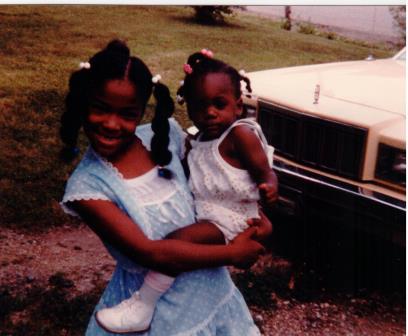
Just as the grownups promised, Ms. Bell did the whole labor and childbirth thing outside of my presence and one day there was this tiny little brown baby girl at her house. I remember just staring at her, taking in all her beauty, almost trying to memorize her. Ms. Bell declared us sisters and told me she had given her daughter my middle name to seal the deal. Quietly, along that special gold thread that connected my heart to hers – our middle name, Lynette – I made a six-year old’s sisterly promises to her. Ms. Bell, from that day until the days just before she died, reminded me that I was her daughter’s sister. And her daughter was my sister.

I first embraced Lynette when I saw the importance Ms. Bell put on it by using it to connect two hearts in the same way that nature connected by blood. So I finally learned to spell it and pronounce it correctly. Neither of us sisters chose that name, nor did we know beforehand the significance of that name. But Lynette is like spun gold to me.

My middle name is Lynette. My sister’s middle name is Lynette.