My granddaddy was a Baptist preacher. Daddy was a Baptist preacher. And on that side of the family I have uncles and cousins who are preachers and deacons. It is because of that legacy I choose to be a Baptist Christian.
My Indian/Native American/Indigenous roots show up in common identifying features of my Walker tribe. We as a family talked about what characteristics we got from our Cherokee ancestors that was passed down to my full-blooded great-grandmother, the last full-blooded ancestor in my paternal line more than any other influence in our ancestry. When I was born, a white man who Daddy knew was quoted as saying that I looked just like a little Indian – supposedly he couldn’t identify me out of the babies because he was looking for a Black baby and not a little Indian who later sneezed on him, like a little Indian. And when I wore a particular hairstyle in high school someone crudely stated that all I was missing was a peace-pipe. I’m a Xennial so there are some allowances made for the best of intentions despite the inappropriate language. It is because of that legacy I choose to integrate rituals that are commonly associated with those of Indians/Native Americans/Indigenous Peoples into the rituals that are recognized by Baptist Christians.
My European roots were seldom spoken of, however cannot be denied in my blood memory. In fact, I only heard one family member ever mention a sole white man in my ancestry, and only one time in my life. But my research leads me to assume that I have a legacy that includes roots in Catholicism, and it is because of this legacy that I am sure to include rituals that are more specific to Catholicism than Baptist Christianity in my sacred time.
My great-grandfather was an active member of the United Methodist Church teaching, serving as an usher, and serving as an elected lay member. And this is the legacy my mother and siblings were born into. It is because of this legacy that I have reintroduced one particular ritual into my Baptist Christian sacred time.
My Mothers originated from the Cameroonian People. This was never discussed in any measure that I can find or ever heard in family stories. But my blood tells me this is true, and it is because of this legacy I include rituals that are characterized by the West African religions into my Baptist Christian sacred time.
The day I was presented to Earth, I was born of a mother of United Methodist heritage and a father of mixed Baptist-COGIC heritage. I was a critical factor in my parents’ marrying and their marriage was the critical factor that influenced my Baptist Christianity.
Just as society generalizes me a born US Citizen/Black American/African-American (with no Hispanic origin), I generalize myself as Baptist Christian. Despite society not making adequate room for my Indian/Native American/Indigenous People roots nor my European roots – I can’t accurately select any other ethnicity, race, or color on any legal forms – I fully embrace being a typical “slavery baby” and acknowledge my African, European, and Indigenous roots in everyday life and with my blood family (those consequences of my ancestors’ choices). And despite my wearing the simplified label of Baptist Christian, I incorporate rituals typically associated with other religions into my personal religious rites and rituals.
My disillusion with “the church” has led me to a place that is much less structured yet feels much closer to pure in my spirituality, religious beliefs, and sacred spaces and times. Evangelism is not my spiritual gift but Teaching is, and with that knowledge I am better able to rest in this non-structured place even when it results in isolation, loneliness, and sometimes confusion. To teach you must first learn and you learn by research and experience – which can sometimes mean laying down what you already know as true to test something that seems contradictory. If you want to become a Baptist Christian, I will gladly educate you on a few important tenets, and then pass you along to someone who will be responsible with your journey, but I’m not anybody’s recruiter. I’m not likely to ever tell you that any path other than being a Baptist Christian is the right path for me. But I’m not likely to ever tell you that being a Baptist Christian is the only way that’s right for you except in agreement.
And I know eventually I will find my place in a family of Baptist Christians who will embrace me wholly regardless of what they think of me – for better or worse – and I will live with more structure in my spirituality, religious beliefs, and sacred spaces and times. It goes without saying that they will embrace my participation in all things associated specifically with Baptist Christianity, but they’ll also embrace my participation in all things sacred, regardless of its label or its roots without condemning me according to Baptist Christian exclusionary guidelines.
They’ll embrace my cleansing rituals that include smudging with sage, perfuming with incense, purifying with Holy Water, sanctifying with Blessed Oil, and praying with beads. They’ll embrace my use of various beads and prayer ropes with my sacred rituals. It will be okay that I have a sacred space at home that includes beads, candles, very specific colors and fragrances, dream catchers, and pictures of my ancestors. It will be okay that this is where I pray and sing and read and study at home. They’ll do this without condemning me.
They’ll embrace the way I recognize and keep the Lenten Season rituals and make that time of fasting very specific to my needs each year. They’ll embrace my choice to occasionally forsake corporate worship inside a man-made sacred place for an intimate solo worship ritual in creation with beads wrapped around my wrist. It will be okay for me to worship at the shores of moving water, washing my feet as I pray silently for forgiveness. It will be okay that I then release my petitions written on paper that will dissolve into that same body of water where I washed my feet, and then rest for a time while admiring all of creation. They’ll do this without condemning me.
I am Regina Lynette. I am more than a Baptist Christian.
Dorothy Lee Thomas was born on October 31, 1925. I’ve only ever heard her called Dorothy, so I’ve only ever called her Dorothy because no one ever corrected me. I wouldn’t dare attempt anything southern like Mee-Maw, but I don’t think anything modern like G-Momma is quite right either. I think I would have called her Grandmother should we have had a relationship. So, as of October 31, 2021, I call her Grandmother.
I feel somewhat lucky to have not made any memories of spending time with Dorothy Lee. It sounds illogical because I also feel tremendous loss from not knowing her. Here is the reason I find myself so lucky. Dorothy Lee’s actions caused many people who knew her a lot of pain and confusion. Should I have known her in the natural during the first nine years of my life I might be stuck with terrible memories and anger and grief as well. But as I get to know her as an ancestor, I get to see the impossibility of Dorothy Lee and can love her from a spiritual place. I can love her from a place where she’s eternal.
The first big thing that happened to Dorothy Lee after she was born was that she lost her place as the baby of the family when her mother gave birth to her third daughter in not even as many years. Now Dorothy was the middle child of a trio of infant girls. Before she could begin to learn what that meant for her, and just as she made peace with the idea of sharing her parents with her sisters, she lost her baby sister. And no one helped her with her grief because no one believed a 19-month-old toddler knew to grieve her baby sister. And no one helped her with her grief because everyone else was grieving a 6-month-old baby. And no one ever believed Dorothy could possibly feel any residual pain of her own from losing her baby sister. But I know she did. She absolutely had to feel it. I have one memory from my life between birth and 36 months old. It’s probably more of a blend of multiple events morphed into one trauma – there are some connectors missing and mismatched details – but it was a memory of something that affected my behavior, shaped my attitudes, and kept me in a loop of abuse and misuse for twenty years before I asked my family if there was such a secret. I saw the pain on their faces and could see that they were reliving, to a degree, the painful event that they swore to secrecy because they believed I couldn’t possibly remember it. And I saw that in order to protect themselves they would have projected that pain on each other. Because the point of my inquiry was to know what was true so that I could begin to move forward and break the loop of abuse and misuse, I left them out of it and continued seeking help to navigate those painful memories. I maintain that my life would have been better if my pain had been considered at the time it happened and I had been taught how to move forward in life from that trauma. But, unlike Dorothy Lee, I was able to get good help years later of my own volition. Grandmother would have been comforted and encouraged by her family as a child through her grief of her baby sister rather than be left to her own toddler devices. And Grandmother would have told my mother to talk to me about what happened to me as a child rather than trying and failing to protect my feelings. Grandmother would have shown Mommy that she was leaving me to my own toddler devices to process and live through the terrible things that happened. Grandmother would have held me and my mother both as she talked to me – boldly speaking to a toddler about things that are too heavy for some adults to carry, empowering me along the way.
Within the first 36 months, Gina needed Grandmother.
The second big thing that happened to Dorothy was that her parents separated. I don’t know the reason nor the length of time of separation – nothing was documented as a divorce at any time, but Dorothy, her sister and her mother were listed on one census record with her maternal grandparents while Dorothy, her sister and her father were listed on another with her father’s auntie. This is also the year of a few family deaths, none more significant than Dorothy’s mother. Dorothy was just 14 years old when she lost her mother. I know two things about losing your mother as a teenager. First, no one in the world can explain what it is like to be the baby girl of the family and to lose your mother just as you are becoming a lady unless it happened to you. Second, grief is just as unique as the person who is experiencing it and no two people grieve alike. Dorothy was going through a second loss that I know no one helped her through. Worst case scenario she was a burden to be ignored or passed off. Best case scenario, everyone was so busy making sure she was provided for and had care that no one had time to care for her. But Grandmother, who got the help she needed from losing her mother, was by my side when I lost mine. She was the voice, yet again, telling the family how to look out for me and how to get me back up to a place of functionality so that I wouldn’t have to wait until I was an adult to get treatment for grief and trauma. Grandmother would hold me in her arms and let me sob in her chest until my head throbbed and I fell asleep from exhaustion. And then she would tell me that I was the strongest person she knew, that my tender-heart was the strongest part of me. She would say that it was beautiful that I was able to fall apart into her arms, having the courage to both feel and express my pain and to be able to trust her with my most vulnerable parts. I can feel Grandmother’s hands around my face, cupping the tears that fell from my chin and letting them roll down the insides of her wrists. Smiling through her own tears and wiping away my fresh tears with her thumbs, Grandmother would look into my eyes for my silent questions, and she would wait until she could see I got the answers from looking into her eyes.
Dorothy had a baby girl and got married as a teenager and her husband left four months later to serve in World War II. I don’t have a lot of answers about that period of time and maybe that’s something that will be made clear at another time. But Grandmother is who I would have talked to about my teenage relationships and the one person’s advice I would have trusted implicitly. Grandmother would tell me all about my biological grandfather, what the family thought of him, why she didn’t get married until a month after my mother was born, what it was like for her husband to leave for war, and how the relationship ended. I would have made the same teenager decisions I made for the same reasons I made them, but I wouldn’t have made myself sick with doubt and grief prolonging the closing season for those teenage relationships. Then I would have walked hand in hand with Grandmother in places where the grass was lush and green while she beamed at me with pride, knowing I was moving forward courageously, unconcerned that I would have all the relationships I needed along the way.
Teenage Regina needed Grandmother.
Dorothy had a boyfriend who was just as, if not more, significant than my biological grandfather in some ways. This boyfriend saw her talent, shared her talent, and made her an offer she wouldn’t have refused. Her father stood in between her and this dream. I believe this act – one I am certain was made out of love and the best intentions – was the beginning of a horrible downfall provoking Dorothy to lash out, causing regrettable and significant harm to her loved ones. So, because I can know Dorothy as the Grandmother who sang in talent shows and with doo-wop groups, I can spend time with the Grandmother who tells me that I can have everything I’ve ever dreamed of and more. Grandmother calls me her “partner” – because she can see so much of herself in me. I am the one who drives her everywhere she needs to go while we sing every song on the radio at the top of our lungs together. We spend Saturdays together, sitting on the floor in a small room where her phonograph (that still works fine) is stored, listening to records. When it’s my turn to choose songs, I select some vinyl that makes her smile and then choose some things from my iPhone that I know she’ll absolutely love to hate. We’ll sing together and I’ll read liner notes to her while we listen to music for hours exchanging fun facts about the musicians. And she’ll have a couple fingers of something brown and smooth while teasing me for preferring something pink with bubbles. When I see she’s getting sleepy, I begin to put away the records with the same care she taught me when I was very little. When we’ve played our last song for the night, I walk her to her bed and tuck her in just before kissing her cheek. Grandmother knows I can’t sing for shit but loves the way I sing with my whole heart. She laughs at me when I screech out the high notes and when I ask why she’s laughing, she tells me that she laughs when she’s happy.
Dorothy Lee wrote on the back of this photo that she was too flabby and that this was her real hair. She would write addresses and stories on the back of photos that she sent but never the date.
This is the Grandmother with whom I spent last Halloween. October 31, 1925 was Grandmother’s 96th birthday. She didn’t grow up in a perfect world – life dealt its blows often leaving her heartbroken – but she lived with all of her needs met, whether physical, emotional, or spiritual. She tells stories of love and loved ones lost, of dreams deferred and changed, and how to find the beautiful things in a world of ugliness. She smiles at me with her eyes and her heart, knowing that she walked the path she did so that I would have someone holding my hand while I walked the path destined for me to walk. She is happy to do it because with everything I go through, she gets to advise me from a place of experience. When she recalls wondering why such terrible things happened to her when she was younger, it all makes sense when she sees me.
I am Regina Lynette, granddaughter of Dorothy Lee.
When I open my eyes on March 23, 2024, I will have officially outlived my mother. I’ve been thinking a lot about my mothers lately and because I only had one of them in my life, and even then for only the first 13 years of it, I feel tremendous loss. But it is in my blood memory to recognize and acknowledge my ancestors so I have created a sacred space at home where I honor my ancestral mothers. This isn’t a foreign concept for me but this is the first time I am intentionally seeking out my ancestors. I’ve sensed uncles, aunties, my paternal grandmother, and my parents with me in the past – riding in my car, sending lady bugs my way, or while shopping and running errands – and have welcomed their presence. But I never invited them in the way I am inviting my mothers now.
My mothers never lived to become old women – none of them even made it beyond their 60th birthdays. And because my mother died so young, 47 years and 101 days, I always expected that my siblings and I would each have a crisis of sorts about reaching and surpassing her age in our own lives. I watched my siblings approach and surpass the number of years my mother lived and they seemed to have opposite approaches – one seemed to expect death and the other seemed to fight death. And now it’s my turn.
After I reached an age where my dreams seemed impossible, I began thinking much more often about my own mortality and thinking about the possibility of surpassing the number of years my mother lived. I could honestly say that I didn’t want to outlive my mother. I don’t mean that I was suicidal, but that I didn’t want to live. I didn’t have a life I enjoyed and didn’t have children to live for or a legacy to create or fulfill. So what was the point of living? No one depends on my life for anything so if I didn’t enjoy it and there was no obligation to live for anything else, what was the point?
Vacationing in Toledo, Spain during a time where my life dreams seem no longer possible.
Because my mother died from a silent killer, I thought I was being responsible by going to the doctor for all my age-related preventative annual testing. As a result, I’ve been poked and prodded and threatened with numerous illnesses. And supplements have been recommended. And medications prescribed. And as a result of increased focus on preventing hereditary diseases, more small things have been found that need investigating and watching. Several routine visits have resulted in months of ultrasounds, MRIs, C-Scans, and preventative testing in increased frequencies. And it sounds reckless and selfish but I am tired. I don’t want to have a 3-D mammogram and an ultrasound and an MRI every year. Why does that sound reckless and selfish? Because I am in a position where it is both recommended and covered by insurance to have a 3-D mammogram and an ultrasound and an MRI every year to catch breast cancer as early as possible to be able to treat it as early as possible and prevent invasive life saving measures and death. I imagine that every person who has been touched by breast cancer is cringing now. Forgive me. I have to remind myself of the good. I have to forget having my boobs treated like breast cutlets and then having those results compared to an ultrasound and then having those results compared to being on a seat on my knees in the fetal position with each boob hanging down in a cold metal square sitting in a machine that knocks and beeps for half an hour and then having a dye injected and doing it again for half an hour. And while all that is better than chemo and radiation and mastectomy and a painful slow death, all it does is make me think about cancer. And I feel the same way about all the other preventative tests I have to go through annually. After just 2 years of that, I became obsessed with death and believed I was at risk and in bad health.
The next thing to happen as a result of all the things that have showed up on these tests is that with further testing of something suspicious, I have been proven to be in relatively good health. So I got over myself. Even things I shouldn’t be able do to well because of the diagnoses I live with, I do better than I did when I was younger and supposedly in better health. I listened, finally, to the message I was receiving. It’s not too late. And because it’s not too late, I have decided to embrace the belief that I will surpass the number of years my mother lived. And I’ve set some goals to achieve by March 23, 2024. And I am planning a celebration for March 23, 2024. If you are invited, the only acceptable response is “yes”.
I am Regina Lynette, daughter of Donna Maria, daughter of Dorothy Lee, daughter of Odetta, daughter of Peoria. And I have been searching for myself in my mothers’ gardens. But what do I do when all I know is a name, some basic statistics, and a cause of death? I wish I knew if one of them had these ankles – they’re hereditary and I’ll never forgive the ancestor who passed them on to me. They skipped over my parents and none of my siblings got them so I can’t track them down.
Odetta (Cox) Thomas, my great-grandmother, is practically just a name and possibly a photograph along with a death certificate and a few census records to me. She was my great-grandfather’s first wife and together they had three daughters, including my grandmother. She stayed barefoot and pregnant having all three daughters in the span of about 3 years but lost the last of those daughters at just 6 months old. She married young, probably about 14 years old and died young at 31 years old. She died from paralysis and apoplexy (presumably a stroke) due to interstitial nephritis according to her death certificate (it only took me years to decipher the handwriting on the certificate). With this information, I can’t guarantee that she had these ankles.
The last census taken during her life, one year before she died, shows that she was divorced from my great-grandfather, but her death certificate shows she was married when she died, and no name was listed for her husband. She is listed with my great-grandfather’s name on her death certificate, and he is noted as a widower before his second marriage. What’s for certain is that she was not living with him nor her children – at the time, she was a roomer in a house with her parents. Somewhere between 1920 and 1930, my great-grandparents had some kind of separation – an undocumented/unfiled divorce – and I’m left with far too many ideas of why she wasn’t living with her children. I cannot confirm where my great- grandfather and his daughters were living that year.
Without one single family story about Odetta, it’s difficult for me to even make assumptions about the way life treated her. Even though she married at such a young age, it wasn’t atypical for the time. All signs point to her death being sudden and unexpected – her age and her immediate cause of death support that assumption. She has been laid to rest in Mt Carmel cemetery in Memphis. We visited this cemetery with little hope of finding her or my other relatives buried there. The cemetery has become an “eyesore” because the company that owned it and another cemetery where prominent black people of Memphis are laid to rest went bankrupt. There was a local group who worked to clean it up some back in 2014, but as of 2017 it was still a mess. There are broken headstones, those that are now illegible, and of course I had no access to anything with a locater for the graves. As I walked through the areas that I had enough courage to enter, I thought of Alice Walker describing her experience in seeking out Zora Neale Hurston’s resting place. I had hoped to feel the souls of my ancestors there, but I can’t say that I did. What I did recall though was Mommy lamenting that she didn’t take good care of the graves – tending to them and making sure they had fresh flowers regularly – and based on what I know now she must have meant those in Mt Carmel. She believed she wouldn’t have been able to find them.
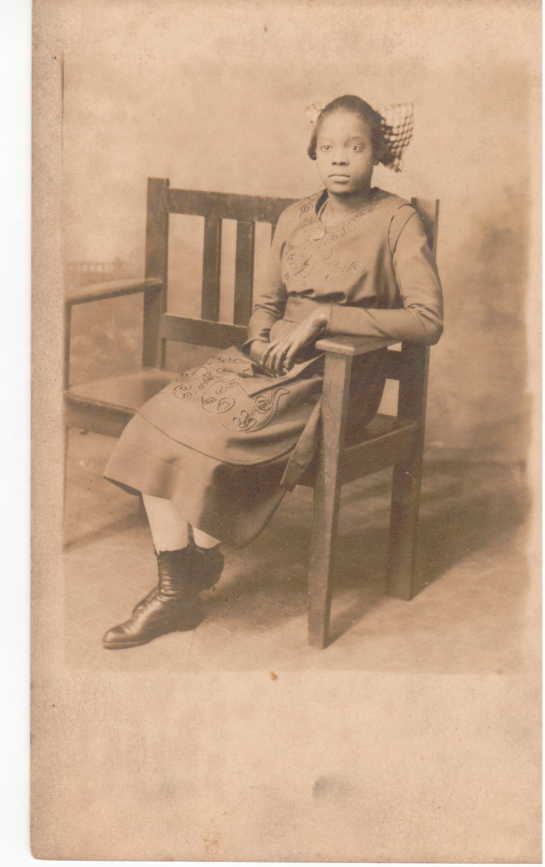
This photo post card was found in my mother’s things and based on what was written on the back of the photo, I assume this to be Odetta Cox Thomas. I want desperately to see myself in her face and in her eyes. And I really want to know about those ankles. Where is my great-grandmother’s garden and what was in it for me? At least I know her name and her mother’s name. Perhaps in speaking her name I will find her.
Peoria Cox is my 2nd great-grandmother and I know even less about her than of Odetta. Peoria’s parents remain unknown to me except that her mother was born in Mississippi, but without any name for her mother or even Peoria’s maiden name, it is difficult to find them. Even if I did find a couple with a daughter named Odetta (and possibly a sister named Mary), I couldn’t confirm them. But if she passed on these ankles, skipping generations, I will never forgive her.
My 2nd great-grandmother was born in Arkansas and I assume she moved to Memphis with her husband and children when they were young. But the earliest address I find for her is in Memphis where she had two children, including my great-grandmother. Her daughter lived with her, likely until her marriage, and then for some time before her death. Mommy once told me that losing a child was the worst pain to suffer in the world. If that’s true, Peoria surviving her daughter also means she survived the worst pain in the world. Peoria died about 5 years after her daughter. The first census after Odetta died – the last one of Peoria’s life – listed Odetta’s daughters at two different locations. The girls obviously split their time between their maternal grandparents and their father and his aunt. Peoria died when my grandmother was a young woman and Mommy was a toddler, so I also like to think that Mommy spent some time in Peoria’s arms. If Mommy’s arms ever hugged Peoria’s neck, then those same arms cradled me and by association I have been touched by all of my known mothers.
Peoria’s immediate cause of death was cerebral hemorrhage from unknown causes – another sudden and unexpected death. She lays in the same cemetery as Odetta – Mt Carmel in Memphis. We weren’t able to find her in 2017 either.
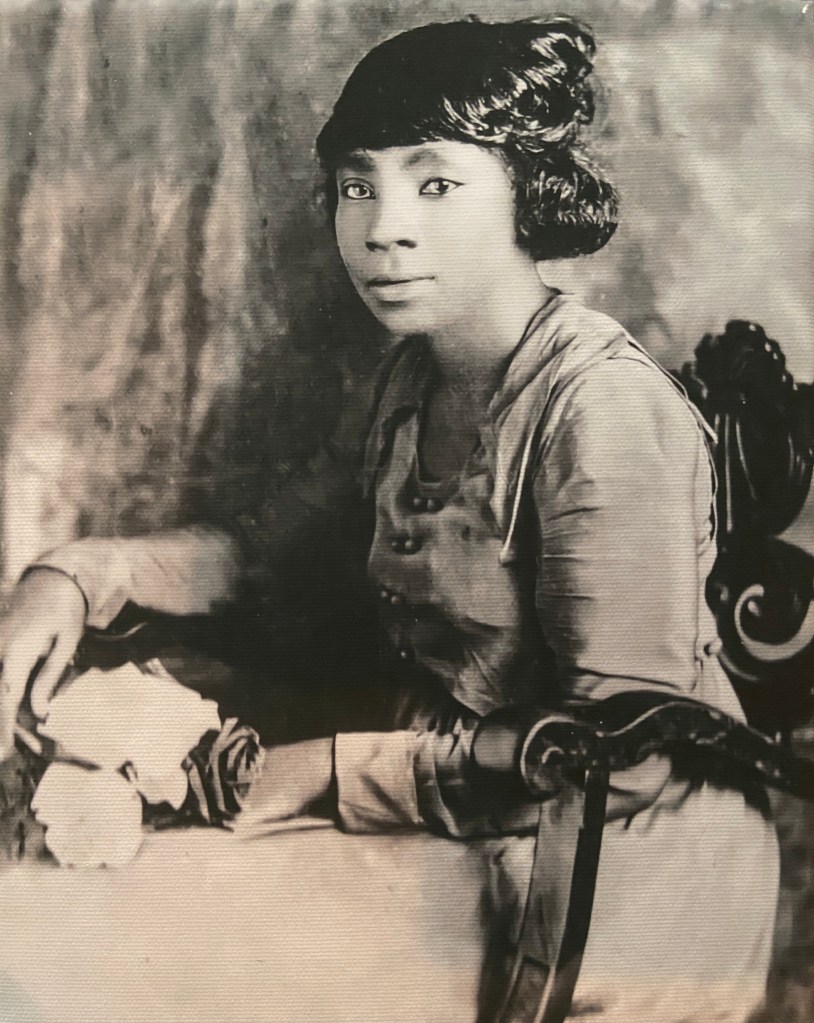
This photo hung in my childhood home, and I know I asked Mommy who she was, but I cannot remember which relative she said. Based on the information I have I am making a guess that this is truly Peoria. I want desperately to see myself in her face and in her eyes. And I really want to know about those ankles. Where is my 2nd great-grandmother’s garden and what was in it for me? At least I know her name and her mother’s birthplace. Perhaps in speaking her name I will find her.
DNA testing identifies us with the Bamileke Tribe of the Cameroonian peoples. This testing goes back along the line of mothers, so I like to think that Peoria passed down some traditions, recipes, and rituals from Cameroon even if the daughters didn’t know the origins. I understand that many things have interrupted the passing on of our culture – Peoria is listed as mulatto on at least one piece of documentation suggesting that one of her parents was white; slavery and colonialism worked against the passing on of anything sacred; and divorce, death, and moves across country left young girls without the ones who would have passed down anything of cultural significance. But there is always something that remains imprinted on our DNA and there is a such thing as blood memory that keeps our hearts beating to the original drums. And our souls are always looking to return to our first homes – our mothers.
I am Regina Lynette, daughter of Donna Maria, daughter of Dorothy Lee, daughter of Odetta, daughter of Peoria.
I am Regina Lynette, daughter of Donna Maria, daughter of Dorothy Lee, daughter of Odetta, daughter of Peoria. And I have been searching for myself in my mothers’ gardens. Even though I didn’t want to find myself in Dorothy for a long time, getting to know her as an ancestor has helped me to see some seeds of myself in her garden – because of Dorothy I am predictably unpredictable, and have a wandering spirit.
Dorothy Lee Thomas (Terry) was my grandmother. She was never known as grandmother but as Dorothy to Mommy’s children. Her given name is Dorothy Lee. Her maiden name is Thomas. And her married name was Terry. I don’t know if she ever married again after Warren Thomas Terry – never known as grandfather and causing some confusion with his middle name always listed and the same as my grandmother’s maiden name. She was called Dorothy. She was called mean. She was called unstable. And she was called unpredictable. Later I would know she was called a free-spirit and she was called independent.
I had a baby doll that I slept with from my first memories until she fell apart. I named her Sleepy Baby because she was sleeping, and she was a baby. I was never creative with naming my inanimate objects – my favorite teddy bear is named Bear. Sleepy Baby was all I knew of Dorothy for years, because the baby doll was a gift from her, and I remember Daddy telling me so. I don’t believe I ever met my Dorothy. I don’t have a lot of details about the last time she was in Memphis visiting the family but when Mommy was found chain-smoking and rocking in her bed, Daddy announced that Dorothy didn’t have to go home but she had to get the hell out of there. He drove her to the bus station and then Dorothy was gone. Mommy is the one who called her mother unpredictable most often. Most of the memories she shared were about times that started out happy and ended horrifically, sometimes ending in some kind of violent behavior.
This is the only photograph I have with Sleepy Baby. Not sure how long I thought holding her by her feet was the best idea. I have memories of rocking her to sleep in my arms before I went to bed myself.
Sleepy Baby was a doll made of a plush pale pink stuffed onesie with a pale plastic face, pursed pink lips, and closed eyelids. Her onesie was hooded, and yellow tufts of hair peeked out from underneath the seam. The pale pink satin ribbon was never tied in a bow as it obviously was when I got her but dangled the way ribbons on pigtails dangle at the end of the school day.
The vast majority of what I know about Dorothy consists of a timeline of events from genealogical research and imagining her reactions and responses to life events through a filter of my own experiences.
Dorothy was born on Halloween in 1925 to parents who were presumably married at the time, ages 16 and 22. She was the middle child of “stair-step” daughters – her older sister was just about 15 months older, and the baby was just about 13 months younger. Her baby sister died at about 6 months old. She and her older sister were just toddlers at the time, so I imagine the baby was just a family story for her. But it was one that she never forgot. We found a list of “characters” in Mommy’s baby book where Dorothy listed family members and Essie Mae was included. I think in a more positive series of events she would have been considered the family historian, always writing long notes on the back of photographs and in Mommy’s baby book. Dorothy would lose her mother when she was just 14 years old and then go on to live with her father and his aunt for at least the next two or three years.
Dorothy Lee, mother of Donna Maria, grandmother of Regina Lynette.
This photograph was taken during Dorothy’s high school years – I believe she attended Booker T. Washington in Memphis – and is the best photograph I’ve seen of her.
Dorothy has posed for at least one other professional photograph that I’ve seen and sent a few snapshots in letters. She wrote on the backs about how bad she looked or that she had been ill in the photographs.
I’ve compared my high school photographs with Dorothy’s trying to find myself in her face.
Regina Lynette, daughter of Donna Maria, daughter of Dorothy Lee
Here’s a picture of me in high school, wearing Fashion Fair Cherry Wine lipstick just because it was Mommy’s signature color.
Please excuse those ends. My ends hadn’t been trimmed for about 5 years and I was taking off 3 inches at a time that summer to avoid a short cut that I was not allowed to get. A few months later I turned 18, my father’s age of hair-cutting consent, and chopped it down to a chin-length bob – best decision ever.
From my own experience of losing my mother at age 13, I can assume that Dorothy was wounded emotionally in a way that only a girl-child who loses her mother in early teens can understand. I know what it is to be a Motherless Child and to be shattered by that loss. Did Dorothy have suicidal thoughts when her mother died like I did? Did she make a feeble attempt at killing herself, wanting to be wherever it was that her mother was like I did? Did Dorothy have the same “slips” in her mental stability – and by “slips” I mean instances where your mind plays tricks on you rather than remaining in the rational and logical – that I did? Maybe she sat at the front door waiting to see headlights that meant her mother was coming home from an evening errand as many times as I did. She might have seen an usher at a church she was visiting who looked like her mother and imagined that she was back and would explain how she came back to tell her that she was in witness protection and had to fake her death. If Dorothy had any strong identity with a parent, it was likely with her mother and the loss would cause her to struggle going forth. Did the family worry about her yet spin out because they had no solutions for their own grief, much less hers like my family? I bet it was a critical break in Dorothy’s life that affected all the days of the rest of her life, and likely the first one of many.
I know that Dorothy sang well even though I never heard her. She sang in talent shows and was asked to join a male singing group when they wanted to add a female voice. If I remember correctly, this was The Platters – she was dating one of them – and I suppose this was before they added Lola Taylor. The dates don’t match up to the story in my head so maybe it wasn’t The Platters but whatever the group, as the story stands, I can imagine Dorothy might have gained some fame from joining this musical group. She wasn’t allowed to join them – Daddy Rod didn’t let her go – and I wonder could this have been the cause of a second “slip” in Dorothy’s mental stability. She probably lost that boyfriend and a dream of singing all in one single blow. This is the last time I’m aware of hearing her pursuit of a singing career and what a knock-out punch it must have been to have a dream snatched away from you. I do believe this happened shortly after her mother’s death and before her daughter was born but I have no idea of the dates to confirm. It’s exciting to know that Dorothy performed in talent shows all around the city of Memphis and heartbreaking to know that she wasn’t able to pursue a dream of a singing career. If a dream deferred causes the heart to be sick, what in the world does a dream denied cause? Another “slip” in Dorothy’s mental stability, I believe.
I was in second grade when Dorothy resurfaced for a matter of months until her death. This little girl had lost both her grandmothers and was about to gain a great-aunt and an uncle.
This is the first time I visited my “new” great-aunt, uncle, and a distant cousin in California. It was shortly after Dorothy’s death which effectively ended Mommy’s estrangement from her family, though I don’t think Dorothy was involved in the cause for the estrangement.
I imagine Dorothy as a wounded child who never found significant healing from her disappointments and the bitter side of the unfairness of life, causing her to act out sometimes. I believe Dorothy did the best she could often finding that it wasn’t enough, and maybe that made her stop trying. And in her hurting state, Dorothy probably did more than her fair share of hurting other people. Does this mean that if she had a different relationship with her father or with her sister or with her first husband that she would have been kinder? Maybe. Maybe not. If she had a successful singing career instead of a teenage pregnancy and unsuccessful marriage, would she have been stable? Maybe. Maybe not. If her mother had not died too young at age 31, would she have been more predictable? Maybe. Maybe not. And broken hearts don’t all heal the same way.
Because I want to find a kindred spirit in my grandmother, I look for myself in her garden and when you search for something you’re likely to find something – whether or not it’s truly the thing you were seeking. I’ve been called independent, like Dorothy, and I imagine I plucked those seeds from her garden. I’ve been called a free-spirit (even though I’m not sure I agree), like Dorothy, and I imagine some of those seeds came from Dorothy. I’ve been called mean and I’ve hurt others when I was hurting, like Dorothy. I’ve been called unstable, like Dorothy, and live with a Bipolar II Disorder diagnosis, unlike Dorothy. But my favorite and the one I’ve massaged the most is that I’ve been called unpredictable, predictably unpredictable to be exact.
My former college roommate called me predictably unpredictable, showing no surprise when I did or said something that seemed contradictory to my typical choices. Yes, I could be unpredictable in a way that negatively affected my loved ones and my close ones, but thankfully it’s often more benign. Some of my atypical choices receive a response similar to, “I would never have thought you’d ever want that one” or “I can’t believe you actually did that.” And generally, it’s about things like the time I sang at The Apollo Theater, when I couldn’t give up coffee and then just because it was a Saturday I lost all desire for it, or the time I called the floral print mug with a gold handle perfect. Why in the world would I jump up on stage at The Apollo Theater? I don’t sing well, even though I love to and give it all I’ve got. It was a fake show during a tour of the theater, but not something you can expect me to ever do. It was a once in a lifetime thing, and my hair was sassy, and I was enthralled by the fact that I could touch the stump for good luck, jumping on the same stage where Ella Fitzgerald first sang. I had spent my life trying not to become addicted to coffee but it became hard to start mornings without it. And then I woke up one Saturday and didn’t want any. It would be at least three days before I noticed that I didn’t want any coffee – even with the smell of fresh hot coffee brewed with cinnamon each morning – and that was that. That floral mug would have been the perfect balance to all the things I find rustic and casual. And it’s probably the only fancy mug I’ll ever want.
I am Regina Lynette, daughter of Donna Maria, daughter of Dorothy Lee, daughter of Odetta, daughter of Peoria.
I am Regina Lynette, daughter of Donna Maria. And I have been searching for myself in my mothers’ gardens. It turns out that Mommy made me want to be a good wife, a great mother, and to homeschool my children while effectively managing my household.
Mommy was strong and independent, courageous and strategic, and determined to make her life better after every choice that she considered less than ideal. Even though she chose to marry a physically abusive man in her very early 20s, she made a better choice and left him. Even though my older siblings were latchkey kids far too young and were basically unsupervised after school because she was working several jobs to provide (food, shelter, and a Christmas performance at levels that I would never experience), she was heavily involved in my education and I was never home alone after school. I had assistance with homework and projects, and she planned out my educational path up to high school graduation with the understanding that college would follow. I had my marching orders as far as my education was concerned and I learned from her the power of demonstrating and documenting your intellect. By the way, I would never have known my older siblings didn’t have the same hands-on support from Mommy – they both exceeded my educational achievements leaving me to wonder if I would have been a disappointment to my parents.
Mommy had a natural aptitude to many things and though she dropped out of school after her first year of college, she was very intelligent. Her lack of a degree (and whatever other influences) stressed to her the importance of my educational goals, which she infused in my every thought and action from my earliest memories. She praised me and made me feel like I was the smartest person in the world with every academic or intellectual achievement no matter how small. She sent me to daycare (I didn’t do pre-school) with her own learning assignments for me – things she wanted me to already have achieved before starting kindergarten and considering I would be older than the kids in my classes (my December birthday meant I started Kindergarten at 6) she wanted me to stand out. Thankfully, the teachers and caretakers took her seriously and I was learning things no other kid my age (in my educational bubble) knew. I was reading at age three and she seemed to believe that meant I knew every word that existed. Car rides were filled with my reading every word visible – states on license plates, signs, street names, and everything in between and out. When I pronounced the ‘T’ in Chevrolet or the last “S” in Arkansas, she giggled, corrected me and we had a whole conversation about words that had silent letters – which I thought made absolutely no sense. She always tried to teach me grammar and spelling hints or rules if it applied to whatever on-the-spot learning occurred while running errands.
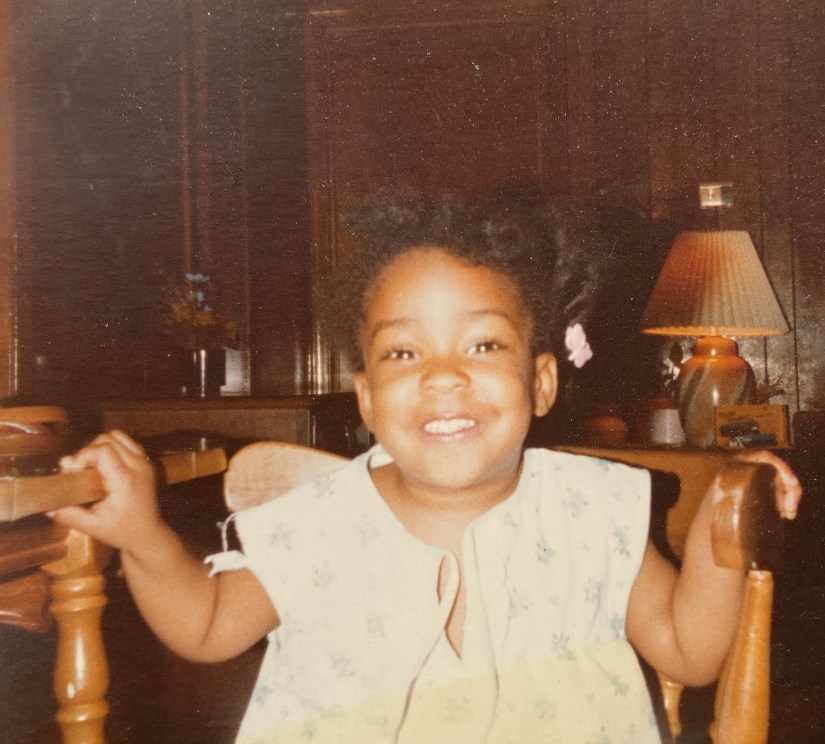
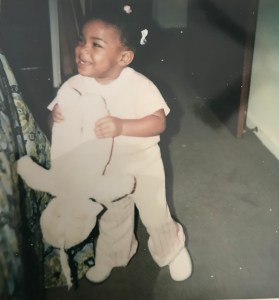
Me at three. God was merciful with those edges over the years. He allowed me to keep ’em and they’re pretty strong, but they won’t lay down for all the relaxer, hot combs, and edge control in the world.
She took a great interest in my lessons and drilled me on concepts outside of the school curriculum – an expansion of the lessons. And when it was obvious that I was more advanced in some ways than my classmates in my neighborhood public school, she set about making a plan. I remember when she outlined her plan. She wasn’t talking to me directly but I was in the room and somehow I knew she was also telling me the plan and giving me directions. She was venting about my schools and how absurd the curriculum and teachers were and I felt intimidated – she thought I was the best – and I was at the top of my classes academically and physically (everyone thought I would surely be very tall but apparently I just got all my height early) – but I had doubts that I really was as smart as she thought I was and the idea of disappointing her worried me. She was upset that I wasn’t allowed to choose a book above my reading level in the school library so she took me to the public library for my reading where she approved of my books – which had to be above my current reading level. (She would have me read a couple pages and if I got through it too easily I had to find something harder.) She was utterly appalled when she found out I was allowed to administer spelling tests in second grade because I’d make perfect scores on the pre-tests (a quiz on a list we hadn’t been presented with or studied in class beforehand). My teacher didn’t know that with my parents I studied my whole spelling book in the first couple weeks of school, noting the words I didn’t already know and studying them. My teacher asked me how I managed a perfect score on words I supposedly had never seen before. She was disappointed to know I studied ahead of the current lesson at home – like I was cheating in some way. She proceeded to drill me on the hardest word in each lesson going forward until I missed a word. Then somehow she seemed both pleased that I missed a word and that I knew almost all of the words (but how could I know what she was feeling since she didn’t say and I didn’t ask).
The first three years of my public school education were spent at Fairley Elementary School.
By the time I was starting third grade Mommy used someone else’s address to get me into a school that had an Optional Program (honors classes) – something another parent she knew suggested to get my foot in the door. I was tasked with checking in with my teacher on what it would take for me to be moved to an optional class as soon as possible – because another kid we knew was moved to an optional class early in the first semester and I wasn’t when she was certain I should have been. And we wouldn’t have to use someone else’s address if I was in the Optional Program so quicker was better. Mommy wrote letters to my teacher and insisted that I beg her to move me to an optional class, press her to give me an anticipated date when I could move. She even wrote to one of the teachers in the third grade optional classrooms. My second semester of third grade I was tossed into an optional classroom and suddenly my superior academic prowess dimmed significantly. The children in that class seemed eons ahead of me and they laughed when I didn’t know something while the teacher was exasperated and had no patience for me or interest in my catching up to the rest of the class. But Mommy would not be daunted – she assured me I was both worthy and able to keep up, and I did. I did it because she believed I could. In hindsight the teachers probably were annoyed with Mommy’s persistence.
At Oakshire Elementary School, I was constantly scared of failing and of achieving at the same time. In the Spelling Bee, I purposely misspelled my word because I didn’t think I should know that word. And I also didn’t want anymore pressure – I only wanted to go sit by my mother.
By this time, Mommy had planned my grade school educational path through a number of schools rated higher than my neighborhood schools on through high school graduation – I guess she was still considering colleges at the time. The only detour I made from her plan happened after fifth grade. The school system decided to take all the schools’ individual Optional Programs out and put them in one school, grades K through Freshman level (because it was Junior High rather than Middle School back then – 9th grade has since been moved to all high schools). I was tasked with checking in with my fifth-grade teacher regularly when Mommy found out about that school because the first class of students for each grade had to be recommended by a teacher. With all the schools in the system, this new school would only have two classrooms for each grade, limiting the number of students who could attend. After that first year, students would have to test into the school. Fortunately, this teacher believed in me very early on and worked along with Mommy to make sure my grades supported her recommendation. When Mommy had me ask her specifically and plainly to recommend me for the school, my teacher told me I was already on her list and she actually beamed at me.
I was proud to be in the first classes at John P. Freeman Elementary and Junior High School. My confidence in my intellect bloomed and crossed into arrogance. I also began noticing boys in 7th grade. I was driven to distraction by the smart ones. I guess you could say I came out as sapiosexual.
While I was at this new school, feeling especially smart, Mommy talked to her brother in California about his job path – which all I knew was that it had something to do with computers which sounded fun – and determined that I would follow his footsteps to getting a good job in a good industry. She had been watching me from younger years when I first saw a computer at her friend’s house. We called on one of her work friends in the days when I needed a sitter who just happened to have a computer at home that I spent hours exploring. When she saw I was excited about it she was certain computers would be my life and I got a computer with a programming book (because what small child interested in playing computer games doesn’t need to know computer programming).
Mommy died before I went to high school but with a sister working at Mommy’s designated high school for me and with the ability to continue in honors level courses there was no issue with my attending that high school. I was even wise enough to quiz my junior high guidance counselor on how to ensure I was able to attend the school so I’d be prepared – I had learned from Mommy how to make sure I was doing what I needed to get to the next level we wanted rather than allowing other people to decide what my next steps were.
I’m certain I would have continued to prosper academically if she had lived beyond my high school graduation. I probably would have continued to prosper academically in high school if my father hadn’t married my step-monster. But living with an abusive monster while emotionally abandoned by my father who had remarried before I could even get a grip on grieving my mother, and the deep depression that followed (undiagnosed) made all things school a struggle. I nearly wrecked my entire grade school academic career with my last semester of high school.
At Memphis Central High School I completed my grade school education and prepared for college, making progress on Mommy’s educational goals for me without her direct hand for the first time. I graduated with a major in Computer Science and a minor in Mathematics in high school.
I tried to follow the Computer Science educational path in college, but I remained drowning under water through all five years I was in undergrad, starting out on academic probation my second semester (thus five years in college rather than four). Eventually during the course of those five years I changed my major to one that my family found quite disappointing. Regardless of the academic struggles, I self-identified as smart and carried myself accordingly. When I didn’t know something, it upset me. Whoever introduced this idea that I didn’t know or understand would then be interviewed until they were exhausted so I could learn this thing I didn’t know, and I wanted them to provide resources to make sure I was learning the right thing. When someone assumed I didn’t know something I was arrogant. “The audacity, the unmitigated gall that you would assume I wasn’t as smart as you?” And I’d roll out a stream of information on whatever the topic was – even if I wasn’t sure about it or knew it wasn’t entirely accurate – and dare you to think less of me ever again. Those who were arrogant about it, clearly needing to assert themselves over me were usually dismissed. Those who continued to present ideas and concepts whetted my appetite for learning more and more about that topic.
By the time I graduated from The University of Tennessee at Knoxville I was exhausted with school and thought I was going to make a difference in some other child’s life, ensuring that they not only got a great education but that they enjoyed the process and made their own choices in guiding their path.
This brings me to the harvest I reaped from Mommy’s garden, seeds I’m not sure she knew she planted. She was home with me for at least half of my years guiding and supporting my educational path. I remember at a very young age determining that children needed their parents at home for them after school because you couldn’t trust their education to any school system. While I was in college, I dreamed of having babies (birthing or adopting or fostering) and homeschooling them. I crafted a learning path in college dedicated to equipping me to be a good wife, a good home manager, and a great mother – in addition to early childhood education and child development I chose courses in family systems, interpersonal communication, and literature for children. That desire is consistently in my heart, surfacing in various manifestations daily, always and unfortunately as a dream deferred. We’ll talk about how I feel about God’s apparent plans versus mine (and Mommy’s) another time.
I am Regina Lynette, daughter of Donna Maria, daughter of Dorothy Lee, daughter of Odetta, daughter of Peoria.






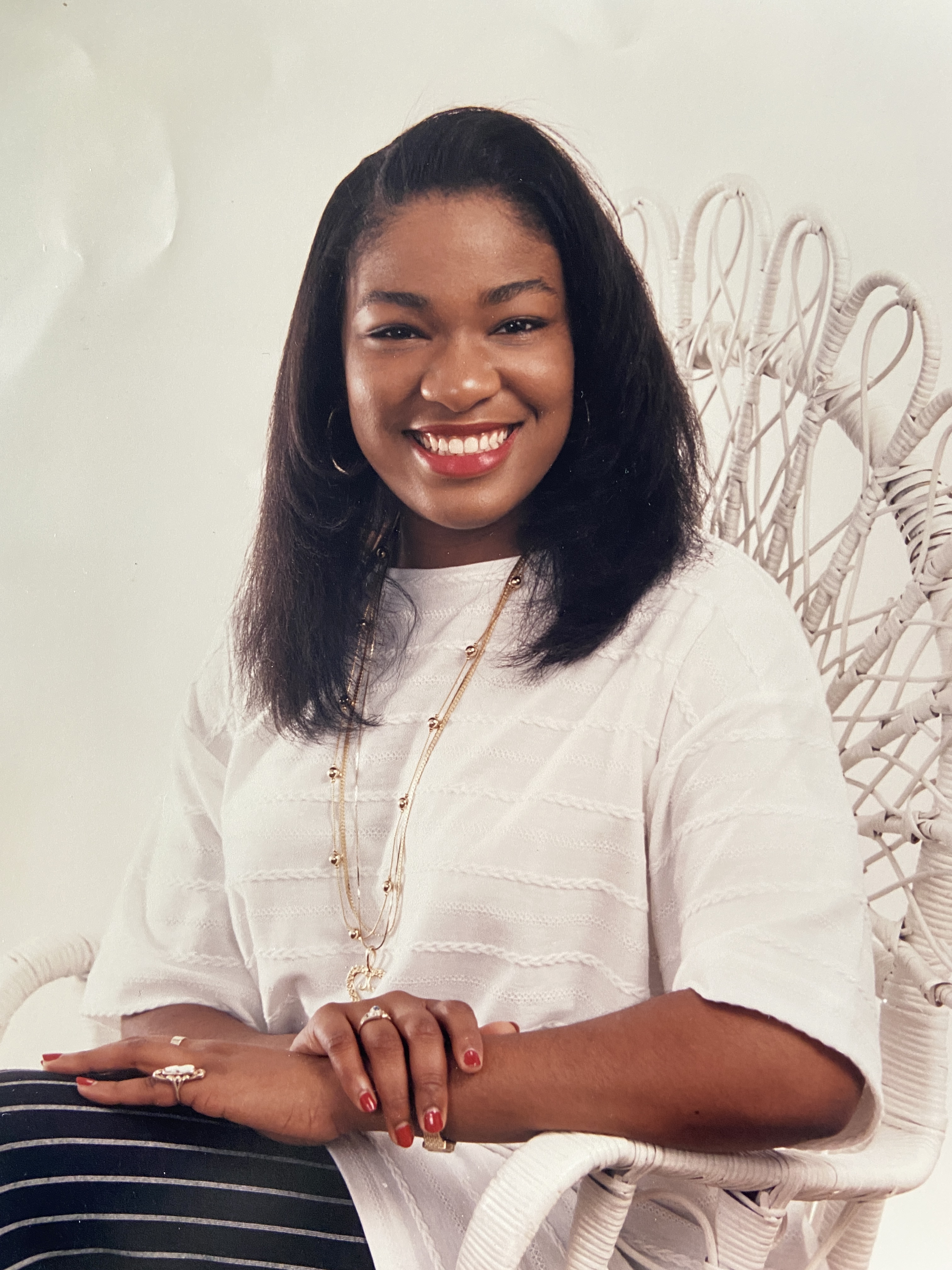
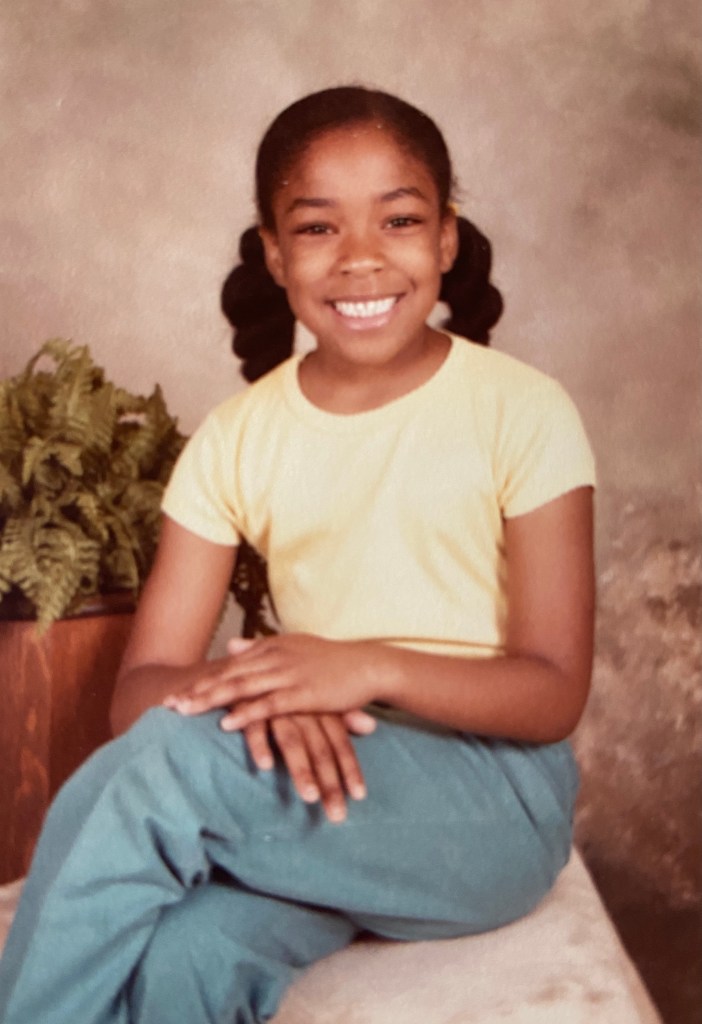


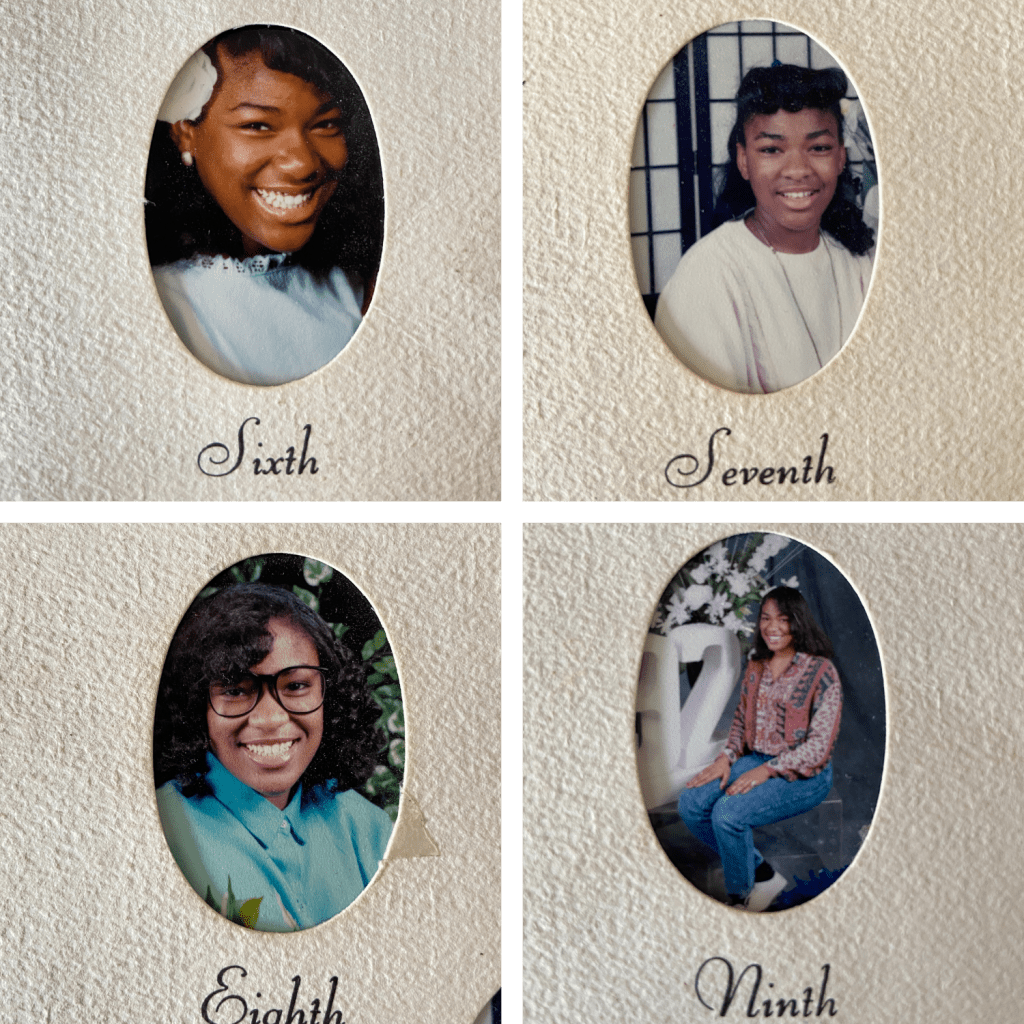

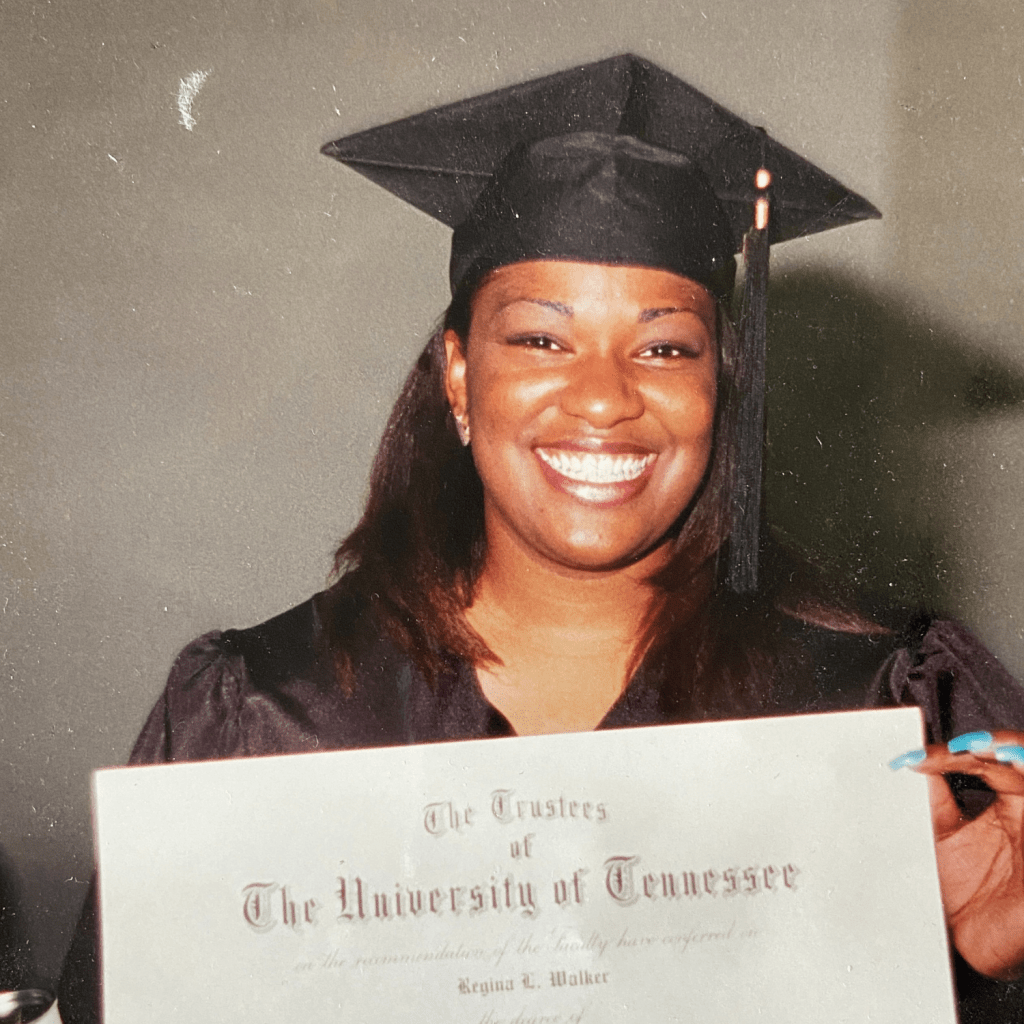
 I am Regina Lynette