5 Min Read, Mental Health

I love my therapist.

I am a black American Christian woman who believes in having a full-on mental health team. I also know that while I am not the only one, I know that it’s not exactly commonplace yet for my demographic. Since I began my mental health journey in college, I have kept my path pretty quiet, sharing information only with people I deemed either safe spaces or emergency contacts. But I think the time has come to say more and say it publicly. This is another reason I decided to do this blog in this manner. Part of who I am includes details about my mental health journey. But you not gonna get the juicy stuff today. Today, I celebrate my current therapist.

I am a black American Christian woman who has a white American woman in charge of her *talk-therapy. And I love my therapist. This year, while watching horrific news about white people killing black people, I found myself in a mental state about racism I’d never been in before. I simply didn’t want to talk to white people about anything and I didn’t want white people to talk to me about anything, simply because they were white people. I didn’t want apologies. I didn’t want questions. I didn’t want greetings or terms of endearment. I turned my nose up at the idea that a white person had words to say. And about a week before my next therapy appointment – the one that came after I realized my sensitivities to white people just because they were white – I needed to decide how I was going to talk to my white therapist. Other than the awareness of her being a white person, I didn’t feel the same animosity or angst about talking to this particular white person and I tried to unpack that some before my session. I didn’t do a great job.

My therapist has an artistic background, has lived in other countries, and has lived in large American cities known for diversity as well as smaller southern cities known for lack of diversity and that was enough to remind me that she was a safe space. During that session I told her that I do not want to talk to white people. She paused the session to make sure she understood what I was saying – because she’s a white person and I was talking to her. Then I tried to say I still felt she was a safe person despite my current feelings about white people and hoped I wasn’t offensive. A few weeks later she reached out to me to ask if I’d heard about a therapeutic product made specifically for people of color designed by an African-American therapist.  I thanked her for seeing my color. This was summer 2020. She is still my therapist and I still love my therapist.

That anecdote says nothing about how I’ve come to love my therapist, nor does it specifically promote therapy. But that anecdote is the demonstration that a therapist to love is a therapist who is right for you and your needs. A therapist to love is one who can handle what life throws you both and can still guide you through those challenging times. A therapist to love is one who sees you clearly and respects you completely. And my therapist is a therapist to love.

When I met this therapist, I was having complications and my chronic mental illness was out of remission leaving me unstable. She was referred to me by my psychiatrist along with a nutritionist. Having had therapy for more than 20 years, I had long developed a process to make sure I got the most out of my sessions. This included self-awareness of issues that surfaced, recognition of things that just weren’t working, and an acknowledgement of the level of disfunction my illness caused versus the level of disfunction my unresolved issues caused (which means I had to accept that sometimes I needed a pill and not only behavior changes).

There were a couple of problems immediately apparent to me in the first few sessions with this therapist. First, I wasn’t going to be in control of this process in the way I had been with previous therapists. Second, I didn’t have the energy, courage, nor foresight to take the reins of this process in the way I had done with previous therapists. Bumping up against that those first few sessions made me reconsider being under her care. I always had an introductory session or consultation before choosing a therapist and could establish my needs at that time. I just made an appointment with this therapist based on my chosen psychiatrist’s referral. But I decided to continue because in this case, my psychiatrist, talk-therapist, and nutritionist – my mental health team – all knew each other and could discuss my progress together and I wanted to see the benefits of that arrangement. So, I decided to “let go” (which ended up being the focus for at least a year) and stopped planning for my sessions. I would just show up and follow her lead. I found that the sessions where I had absolutely nothing planned to discuss were the best sessions. We were still getting to know each other, and I wasn’t really giving her much to work with – I wasn’t showing up and presenting myself to her in the sessions but was open enough to let her sort of rummage around and see what we could work on. And in time, she got to know me. She got to know the characters in my life. She knew when to pause a long time because she could see me thinking. She learned when to either re-direct or end the session because it was just too much to handle. And she learned how to check in with me at the start of each session to see how to best direct our time. Now she has a better handle on me than I have on myself in some ways and I trust her with my everything. That’s a therapist to love. And I love my therapist.

Only you know what you need from a therapist and only you know what’s most important to you in a therapist. However, when I am asked about what I’ve learned I need from a therapist and what’s important to me in a therapist, there is one thing that I consistently note first – the best professionals are artists. Creatives approach medicine with the idea that every human is different and that every human may respond differently to therapy – both techniques and medications. They understand that the patient knows more about their body and mind than anyone else and therefore require that a partnership be forged to determine a treatment plan (you’ll see this in the agreements in your intake paperwork or it will be discussed during your consultation and/or first appointment). Artists use their passionate natures to fuel their progress. And the patients of creative and artistic medical professionals benefit from getting a partner who holds their hand along the very customized treatment plan to reach the pinnacle of the individual’s health. They lay out a plan based on their education and experience and then stand back and look with admiration and pride at the mixed bag of tricks that the plan actually incorporates as it’s executed. My first artistic doctor beamed with pride with every success I had – we had. He fought to the death my insurance companies and got pissed at the pharmaceutical companies when they caused problems with getting my prescriptions filled. He was very invested in me and taught me to be very invested in my health.

I just wanted to tell the world that I love my therapist. And I know that it is critical that African-Americans seek therapy, and that African-American issues can often only be understood well by African-American therapists – so much so that I want to acknowledge it as fact. And I’ve had both black and white therapists and had positive experiences with both. Have the courage to seek the right therapist for you whether it’s gender, race, color, or any other identifiers and experiences.

I love my therapist.

*I use the term talk-therapy to refer to the sessions provided by my medical professional that rely mostly on talking. There are many different kinds of health professionals who take on this role so I use a broader term to focus on the process rather than the person’s credentials. When I use this term, usually I am separating doctors who prescribe medications from other medical health professionals who focus on a myriad of other techniques.


5 Min Read, Bookish, Social Media Handles

I am Regina Lynette, Tsundoku Sensei.

When I was a baby I fell off a bed head first into a bookcase with glass doors. The glass shattered and a shard of glass was stuck in my right eyelid. I needed stitches and it left a scar that moved, as I grew, a little higher on my eyelid, just under my eyebrow. Since I’ve had it for so long I never see it. But as people get to know me, in time they ask about the scar. When they ask, I always subconsciously search for it with my hands or look for it in a mirror, and then tell the short version of the story quickly because it all sounds horrific.

I suspect it was an early sign that I would be bookish – I needed to be with the books so desperately that I dove right into a full bookcase.

I remember reading for pleasure in the summers while in grammar school, almost always while laying on the bed under a ceiling fan and eating a granny smith apple. As life changed and I grew up, reading became a pleasure for my screened porch and my special strawberry lemonade. When it was difficult to maintain a quiet reading space, I made a reading soundtrack (curated on Apple Music and Spotify if you’re curious) and reading then became what I did in between loading and unloading the machines for weekend cleaning (washer, dishwasher, etc.). I bought fashion handbags based on whether or not they could hold a book and became a shuttle bus commute reader. I got the very first Nook for Christmas. And about eight years ago the unimaginable happened – I found it difficult to read anything at all. I just didn’t even know who I had become.

After years of having a bookshelf filled with books I’d already read, my accumulating stack of new books to be read was unfamiliar and uncomfortable. For a while I continued to buy new books because I believed that when my desire to read returned, it would be wonderful to just pull a new book off the shelf at home and read them all back to back without searching for a new read at the store. But then I stopped buying books because I wasn’t reading them, and it felt like a waste of money. Not buying books felt like giving up on my life. It sounds a bit dramatic, but it is honest. So I thought maybe I should become a book collector. But I didn’t become an avid book collector of pristine first editions and other valuable books nor did I have much interest in carefully preserving the books in my collection. Books are meant to be treated with respect, but they should look loved and that means some of them have battle scars. Spine creases are like laugh lines – little wrinkles that come from repeat happiness. Handwritten treasures, worn covers, and doodles all add to a book’s value to me.

Several years ago I received a book that had been sort of re-gifted – it was a book on grief and was given to me when my father died by someone who had received it when her father died. There was a note inside from the person who gave it to her, and she added a note for me. Then when someone I knew lost her father, I wrote a little note inside and passed it on to her. I just imagine this book being passed around the world forever and having all those little notes inside make the book more valuable in my eyes.

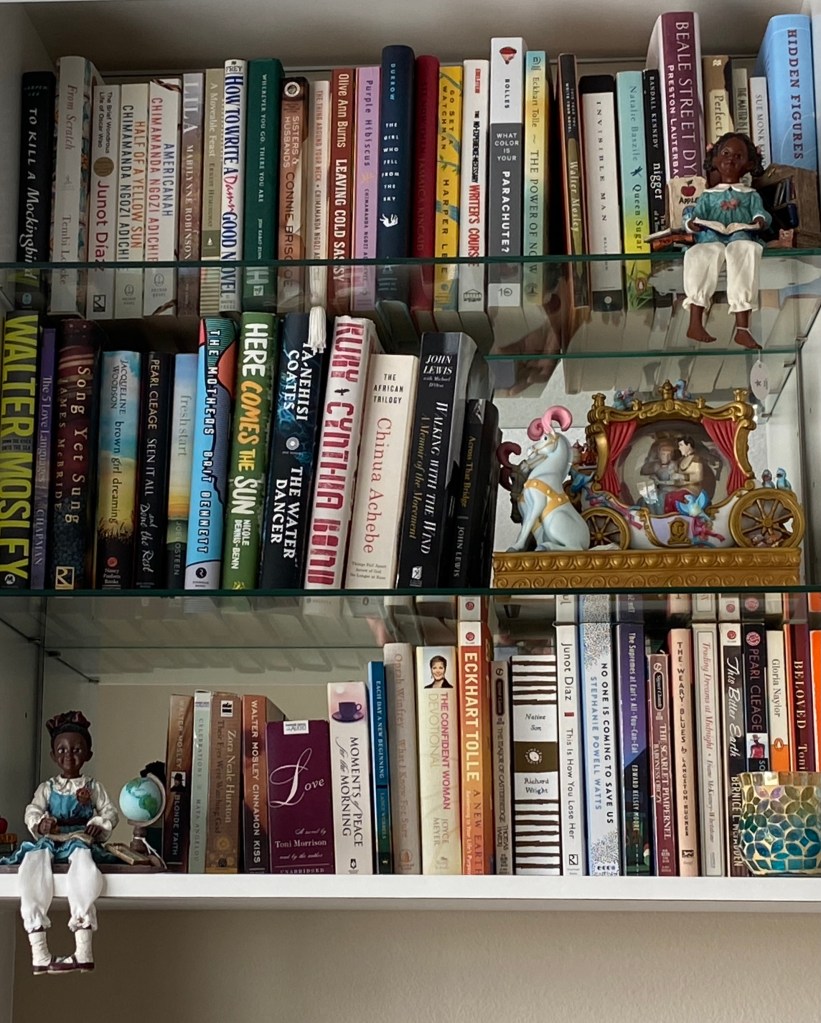
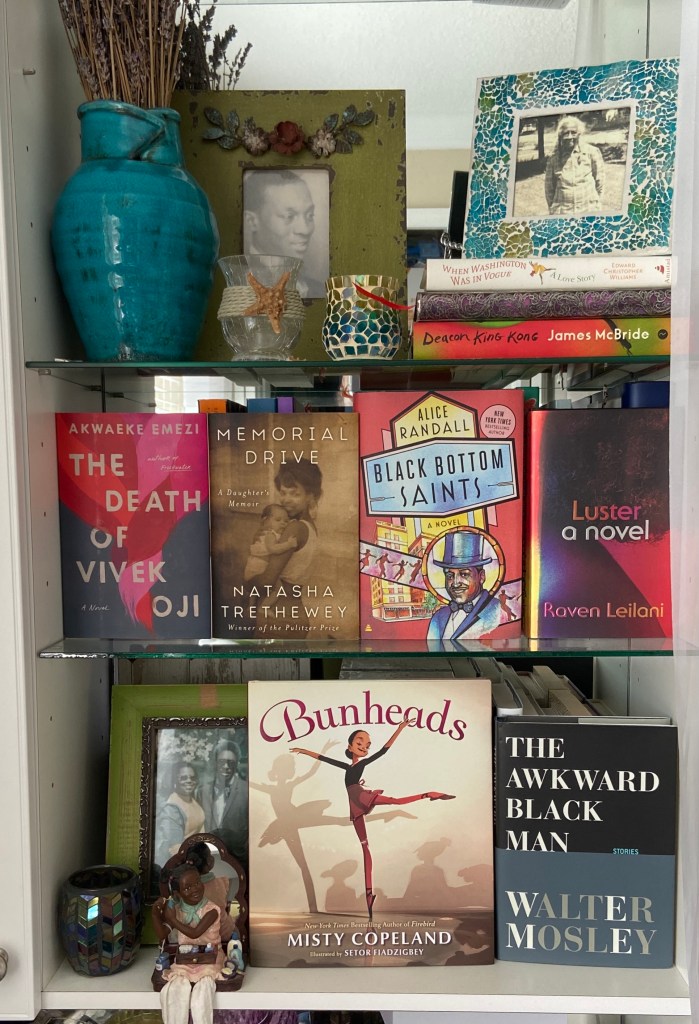
When I first heard the term Tsundoku Sensei, I added it to my list of social media bio identifiers. A Tsundoku Sensei is a master at collecting books whether or not they will be read. Because that’s what I’ve been doing, collecting books regardless of whether or not I will ever read them. I ‘tsundoku’ for a variety of reasons. If you identify with the list below, you might be a Tsundoku Sensei, too.

I began collecting copies of the same book. I read The Alchemist by Paulo Coelho at the end of every year so I buy a new copy every December. Whenever I see a copy of The Color Purple by Alice Walker or Their Eyes Were Watching God by Zora Neale Hurston that has a cover I don’t already own, I buy it. And I have a few copies of books in different formats – e-book, audiobook, paperback and hardback – just because I changed my mind about the format I wanted or because of needing a physical book or new book for a book signing.

I started buying books by recommended authors. Since I haven’t been reading a lot of books lately, I have been collecting books by authors I imagine I would love based on various recommendations or general media exposure. Edwidge Danticat is one of those writers and I was right – after reading her book of short stories, Everything Inside: Stories, I fell in love with her writing. Thankfully, I already have five of her books waiting on the shelves. I am slowly reading through Well-Read Black Girl: Finding Our Stories, Discovering Ourselves by Glory Edim because every time I read an essay I go on a book buying spree.

I buy entire collections or series of my favorite authors. When I find a book I like, I generally go back and read everything I’ve missed and buy everything that comes out later by that author. Even though I consider this a tsundoku-related pattern, I generally read most of the books I buy from these authors like Tayari Jones, Kevin Young, and Pearl Cleage to name three. I don’t have everything that Walter Mosley has written, but I do own the entire Easy Rawlins series (and will be buying the newest one – Blood Grove – early next year), even though I haven’t read the last three.

I buy children’s books. This started primarily when I was in college, majoring in Early Childhood Education with the intention of teaching pre-school until I got married and had kids who I would then homeschool. My plan was that I would buy books for my own teaching purposes to be sure I kept pristine copies for reading to the kids. And these books would eventually line the shelves of my own children’s rooms. That hasn’t happened but I still add to my collection of children’s books to eventually give to [insert kid from the future here].

I buy books written by recently deceased writers. When Toni Morrison died in 2018, I already had more than half of her novels, several audiobooks, one children’s book and a book of essays. However, upon learning of her death I sought out hard copies of the entire collection of novels. I did the same thing when John Lewis died this summer. I bought his children’s book, the graphic novels set, and two biographies.

I buy books that I feel I should own. Most often they are about cultural awareness. I get curious about the literature of certain times and places and collect books on the subjects. I don’t believe I will ever read the books I have about Emmett Till but I want them on my shelves. I may or may not read Michelle Obama or President Barack Obama’s books but I want them on my shelves. And I don’t read or speak or write in French at all (yet), but I own several books in French with no English translations. I’m currently trying to justify purchasing a cookbook that’s written in French – proceeds go to support a cause (in France) but shipping is more than the book but it will be signed by the chef but I won’t use it… All I need is one more ‘pro’ and it’s justifiably mine.

If you identify with me as a Tsundoku Sensei, take a look at some gear for you masters in my shop at ImperfectlyByRegina.com. If you’re not quite a Sensei, I’ve made a list of some of the books that I mention above in my Bookshop.org storefront for quick click shopping – you’ll be master in no time flat.

I am Regina Lynette. I am a Tsundoku Sensei.

10 Min Read, Bookish, Donna Maria Thomas-Walker

I am Regina Lynette. And I am a proud Book Lover.

I grew up in a family of readers. My parents invested heavily – with their own sweat equity – in my reading and education. I was reading by age three and no matter what word I was facing, they insisted that I knew how to read and refused to accept my asking what a word was or telling them I didn’t know it. I began to believe them. I approached everything with the attitude that I knew how to read and therefore I knew how to read all the words. What they obviously wanted me to do was try on my own, develop my own understanding of phonics, and extrapolate my learning independently. Because when I read Chevrolet starting with a ch- like in cheese and ending with a hard t sound, they corrected me quickly with a laugh. And they corrected my mispronunciation of Arkansas – I just stuck an ar- sound in front of the Kansas – with a tone that I understood to communicate that they were proud of me.

I was in kindergarten the first time I saw any library. Once a week we went to the school library as a class to select a book to read for the week. Mommy was very excited by this prospect and when she asked me about my experience it was with the energy of a little girl opening a present on Christmas morning. She couldn’t wait to hear about it and to see the book I selected and expected to be bathed in a euphoria of hope for her child. Unfortunately, she was very disappointed. I explained to her that we were assigned a table with about five children or so, that had a stack of five books or so in the middle to choose from. We could begin reading our books at the table and then we’d do it all again the following week. Mommy was not only disappointed in the book I chose but in the whole system. But she figured if I selected the biggest and hardest book on the table, we could still get to whatever it was she expected would result from my reading and going to the library. That following week, she was more disappointed to see what the hardest book on the table was and gave me a new directive. I was to ask the librarian if I could select my own books from the shelves and this met with a quick no from the librarian. I wonder if it’s important to note that the first time I saw the quote “Ignorance is bliss” was on a poster hanging on this librarian’s desk. Anyway, Mommy took matters into her own hands that very evening – we went to the nearest public library to get my first library card.

The very beginnings of my bibliomania started the first day I entered a public library. The library was not far from our house, but we headed there with haste because they would be closing soon. The goal was to get a library card and then to learn how to pick books to read. We’d return the following Saturday to actually pick books. I have audibly gasped entering two buildings in my life. The second was in 2018 at Basilique Du Sacré-Cœur de Monmartre in Paris, France. The first was the Whitehaven Public Library in Memphis, Tennessee in 1981.

I’ll be describing my experience from the perspective of that five-year-old girl in 1981 entering her first public library going forward. It’s important that I explain that because if you know the Whitehaven Public Library (or ever visit it – if it’s still there) you will be perplexed by my description.

When we flung open the doors to the library, I gasped in awe, and Mommy was so pleased. There were books EVERYWHERE! And there were people – and by people I mean children my age – looking at books and there were just so many! Who knew there were so many books in the world just for children? The sections for children’s books seemed larger than the entirety of my school library. I was about to explode. Mommy calmed me and we walked over to the desk to request our library card. I couldn’t look away from the world of books that was about to be all mine.

The second thing that happened that would change my life was Mommy asked that the library card be in my name. Oh that woman – actually both women, my Mommy and the librarian – became good fairies when they insisted I have my own library card. I never had anything in my own name before and surely this thing would give me immeasurable power. And then she took us on a tour to show me all the sections of books that were available to me. All three of us beamed that evening.

I got my card and I couldn’t resist taking a few books home so I filled my arms as quickly as I could until Mommy stopped me and we checked out. To my disbelief, I would have these books for what felt like an eternity. That these guardians of wonderful books trusted me to care for them, read them, and return them in that much time – I was dumbfounded. And a book enthusiast had found her happy place at just five years old.

Forget that little school library because it wasn’t for people like me. It was for people who weren’t as intimately involved with the written word as people like me and still needed to be gently introduced to the world of reading and of books. I’d also found my people and the best part about my fellow bibliophiles was that there was no age restriction in this group. For the first time in my life children were regarded with the same respect as adults and I felt empowered.

The last time I visited the Whitehaven Public Library was while in high school. I felt like there was barely room for three books and it looked quite small and sad. I stopped going inside because I didn’t want it to lose the grandeur I’d projected onto it as a five-year-old. And it will forever be sacred to me.

I am Regina Lynette. I am a book lover.

* I’ve curated a Bookshop storefront where you can shop titles from my shelves. Click the Bookshop link above or click HERE to see the books I’ve purchased and read for 2020. I am an affiliate of Bookshop.org and I will earn a commission if you click through and make a purchase.