Why would I expect to behave just like all of my family? I was born “off-generation” – my father was old enough to be my grandfather. He was number 5 in a family of 15 children. The brother that I know he spent most of his happier times with was 20 years younger than he. My first cousins weren’t my friends because they were old enough to be my parents. My oldest siblings were old enough to be my parents. In fact, 3 nieces and a nephew are older than I. My youngest siblings were not my friends but my secondary care-givers as they were teenagers in the house when I was born. And because I was born into a blended family – the sole member in the Venn diagram of my family – my home culture was different than that of any of my siblings. The day-to-day norms of my father’s first family unit were different than those of my mother’s first family unit and different than those of my day-to-day norms. Why would I expect to behave just like all of my family?
Why would I expect to look just like all of my family? I was the only child between my parents. I have no other siblings with both my mother’s and my father’s genes combined. I don’t particularly look like my oldest siblings who possess half of my father’s genes and half of their mother’s genes. I don’t particularly look like my youngest siblings and we all have different fathers. My paternal grandfather was gone well before I was born and I never saw a photograph of him until I was an adult. I couldn’t find myself in his face. My paternal grandmother was around for the first 8 years of my life but I probably saw her about 8 times in that life. I couldn’t find myself in her face – she was in her 80s for all of my life which I’m sure didn’t help. I didn’t see my face in that of my paternal aunties and uncles. I didn’t look like my cousins. My maternal grandfather was essentially a question mark and as far as genetics from him he remains a question mark. A photograph was sent to me fairly recently that is unconfirmed but highly likely him and I don’t see myself in his face. My maternal grandmother was unknown to me except in a photograph and I couldn’t find myself in that picture. I didn’t find my face in my mother’s only sibling – my uncle has a different father than my mother. Why would I expect to look just like all of my family?
Why would I expect to be the same person as all of my family? They are my tribe but I was not raised in my tribe. I was raised as if I were an only child. I was raised in a household of three people of three generations. I was raised by people who intentionally raised me with a different hand than the one they’d used to raise their older children. And I was raised in a vacuum of sorts – we were estranged from much of my family both immediate and extended. I was born in what has now been considered a sub-generation, not quite the generation before and not quite the generation after, a proud Xennial. I lived in what was considered “the country” to my maternal family and what was considered “the city” to my paternal family. And much of my life was presented to our community as a series of lies of omission. To be accepted by all the different sectors of my tribe, when necessary for us to interact, I had to imitate a person they would admire and value. Why would I expect to be the same person as all of my family?
When Mommy sent me out with Daddy alone, she told me not to be myself and to not let people see how I really act. I think I’ll just leave that right there for now.
The first years after college graduation were pretty hellish for me (and therefore everyone else around me). If rage could be a person, I was that person. Rage and fury kept my blood between a low simmer and a rolling boil all day every day. During that period of time my sister named me Rebel Gina. The first time she gave me that name she explained that she was confused by my behavior and even pointed out that I looked like I was dressed for combat – I wore Army green and black when I wasn’t wearing heather gray and black which I associated with grief, funeral clothes. My hair was short and red and wild – it was chemically relaxed but I didn’t straighten it with heat and let it dry by holding my head out the window speeding down the highways. I listened to rock music – an unofficial no-no for my family and according to what I’d been told, not intended for black people in general. I wasn’t in church every time the doors opened. In fact, I didn’t have a church home for the first time in my life though I generally attended my sister’s church at the time. And things considered New Age and Occult captured my interest. What was happening was I was experimenting with the “real” me who was screaming to be released from oppression.
I miss Rebel Gina even though she was too angry for me to embrace with joy. And Rebel Gina was not intended to be a compliment of any kind – maybe not quite an insult but it was not intended as a good name. In my rage I loved the name she gave me. It fit what was happening; I truly was rebelling against everyone and everything all day every day. If Rebel Gina wants to come back wearing graphic tees and destructed denim, teaching me how to relax, she’s welcome. If she can simply revel in the joy and charm of Regina Lynette, she’s very welcome to stay.
I can provide you a list of people who would disagree, some vehemently, that my hair is unspectacular. I can provide you a list of people who would agree with that statement. I like my hair. It’s coarse and curly, oily yet non-porous, and it is soft and shiny. It’s thick and grows relatively quickly with little breakage and requires very little product to do what it wants to do – which is be free.
The first thing said about my hair was when I was born and Mommy said to Daddy, “Oh, Bob, she has your hair.” She was happy that I had hair like the Walker side of my family because she found it beautiful. Based on my paternal grandmother and her children and grandchildren, our hair is coarse but soft to the touch; it’s curly when we’re younger and loosens into waves when older; we begin to gray young (usually stark white); and men keep it short while women keep it long (unofficial rules). My mother’s hair was very coarse and relatively thick. Her hair started turning gray at a relatively young age – she kept it colored so I don’t know when it started. And she kept it short – above the shoulder – and kept going shorter. I don’t know the reason behind the length, so I don’t know if it had anything to do with the hair growth itself.
Just months old, Mama had to tape ribbons in my hair – no velcro available in my day.
I’m grateful that the combination of my genes totals what I have today. Daddy would tell me how pretty my hair was first thing in the morning, before it had been combed and styled for the day. I asked him what he meant because my hair was wild and fuzzy, and he said that the hair in and of itself was what he found beautiful. Mommy would style it in plaits or ring curls, and I was to show it off to Daddy when she was done for him to say how pretty it was, loud enough for her to hear. People at church made complimenting my hair a part of the greeting. And whenever my kiddie hairstyle wasn’t quite what someone expected, it was voiced, quite pointedly, that Mommy needed to go back to the standard plaits or ring curls and never waiver again. And what I learned in third grade was that the plaits were supposed to be free to swing. My assistant principal asked if my mom tied my plaits together in the back because she didn’t want them to fly away when really they were connected because it required finding fewer matching barrettes. He was being silly but the element of truth in his joke was that he noticed I’d been wearing the same style a very long time and felt the need to comment. And the culmination of years of peoples’ opinions during my childhood taught me that my hair was part of my overall value.
Ring curls for Easter Sunday – EVERY Easter Sunday
I was not allowed to cut my hair before I turned 18. And when I turned 18, I cut my hair into a chin length bob. I cried. I loved it but I couldn’t stand looking at all the hair that was piled on the floor. And I didn’t touch it much at first – it was so strange not to have enough hair to pull into a ponytail. My stylist wouldn’t do the cut until she received express approval from Daddy. I tried for years to convince a stylist into cutting my hair and just risking whatever punishment I might get but not one of them would do it. And he gave approval because it was promised, not because he thought cutting my hair was okay. And while it wasn’t specifically stated that bob was truly the shortest I would have been allowed to go.
Cutting my hair then, for me, was about looking more mature. I thought a ponytail was for the young. Cutting my hair then, to Daddy, was part of my “wandering spirit”. It was something to experience because I could, and he fully believed I would prefer to return to wearing my hair long. Cutting my hair to this one old lady from my church was a sin and I was on my way to hell along with my parents who allowed it and my stylist who did it. Cutting my hair to other people was wrong because there are women in the world who cannot grow their hair long.
A chin-length bob has always been the shortest length acceptable to Daddy and many of his relatives.
As an adult, I took interest in learning to take care of my hair so that I would have the freedom to wear it however I felt. In college I considered going relaxer-free for the first time. I did it without any education or planning so it wasn’t successful. When I started transitioning, I wore my hair in two braids a lot and sometimes in a bun. After giving up and getting a relaxer touch-up because I truly had no direction, I was scolded for having waited so long before getting a relaxer and was told to never do that again. After trying different cuts and different hair colors I hit a sweet spot with tri-color highlights and long layers on relaxed hair. I was so excited to have found what I judged the perfect style. Unfortunately, it was not maintained by the perfect stylist and a combination of too many chemicals and trying to exercise outdoors in triple-digit temps with no hat created breakage in my crown. Breakage in the crown meant a significant cut so I took some time to figure out what I wanted to do.
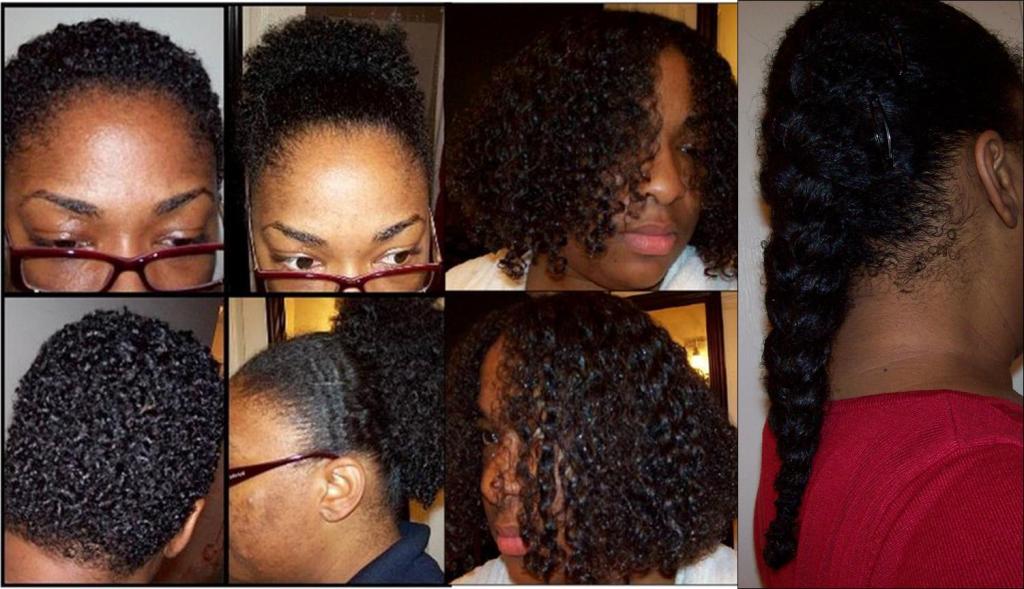
A timely visit to my father’s family made me wonder if I had what they had – I’d worn my hair chemically straightened since I was nine so I didn’t know what my curls or waves would look like twenty years later. So I decided to cut off all the chemically treated hair and go completely natural. I literally went to three shops, including a barber shop, and literally no one would cut my hair. I didn’t necessarily want a particular style, I just didn’t want it to look like it was cut with safety scissors and edged with a butter knife. And they all refused. I made my way to a natural hair salon and during my consultation she told me that the front of my hair should grow a little longer for the cut to look good and to wait three or four months before cutting. I kept it in a protective style for those months and I did the big chop as soon as I could. I had a teeny-weeny afro with tighter curls than I imagined, and I absolutely loved what was on my head. And I learned how to take care of it, and I focused on the care and treatment of my hair intensely. I didn’t necessarily show off my new cut – especially to my father’s family – because I wasn’t interested in anyone’s opinion. But that doesn’t stop people from saying what they want to say. I was told that it was unattractive and to never cut it that short again by relatives on both sides. I was told by people I worked with that it made me look thinner. And I was approached everywhere I went by other black women who asked me about my stylist and products I used.
The first four years chemical free starting with my Big Chop. I didn’t even put any heat on it during that time other than a blow-out in the first year for trimming and to check out my ‘fro.
Cutting my hair then for me was a change I made primarily because it was damaged, and I wanted to try something new. Cutting my hair then for my relatives was just a temporary solution to a problem and something to endure until it was long and straight again. Cutting my hair then for “society” was a statement of my blackness and my woman-ness and my American-ness. I wish I could have photographed the faces of all the people who had made various assumptions about me based on my hair the moment they learned they had me all wrong. And it’s funny that out of all the misconceptions, no one had the same misconception. Cutting my hair then had nothing to do with me as a person. It was the first time I didn’t think my hair was part of my overall value and I was irritated when other people continued to push that message (and burden) onto me.
Along the way, in addition to releasing the idea that my hair was somehow associated with my value as a person, I realized the significance of changing your hair after certain life events. I know there are many cultures who cut their hair after deaths and other losses and to symbolize new beginnings of all kinds. I was only ever advised to never cut my hair. No one told me that the urge to cut that man out of my hair after a breakup was primal and a wonderful release. And when I gave in to that urge, just wow! And no one told me that the urge to go red was a sign of strength – whether you are strong or need to be strong, red hair can embolden you for anything that comes your way. After I graduated college, my sister called me “Rebel Gina” because I was angry and saying “no” to everything I’d ever been taught in life. The hair during that time? Short, red, and wild.
This is NOT “Rebel Gina” but this is a short and red phase of life. It just so happens I regretted this cut myself, but I loved the color.
But just like when I was looking for that fat girl in old childhood pictures, I looked for the girl whose hair was supposedly spectacular. I looked for the girl who was identified in a crowd because of her hair. I searched out the girl who was somehow made better because she had something regarded unique on her head. And all I can see is that there were many other people around me who had hair that was significantly more spectacular than mine. I saw nothing particularly special about my hair. And I have the courage to admit it, the freedom to accept it – my hair is utterly unspectacular. But I understand that when it’s viewed through the lenses of others who don’t have the same kind of flexibility of styling that my coarse, curly, shiny, graying hair allows me that it appears to have some additional value. I no longer internalize that view because it says nothing about me and everything about them. My hair is not a part of what makes me valuable and I’d go as far as to say my hair has nothing to do with my identity. Sure, I can see where I inherited what I have from my ancestors, but apart from genetics, it has nothing to do with my identity. I use it as an expression of something or an accessory sometimes but it’s no more spectacular than my earrings and graphic tees.
Fourth Grade, Oakshire Elementary School – Memphis, Tennessee
Thank you, everyone, who has complimented my hair. I feel good when you agree with me that what I have on my head allows me to be free. And it’s okay if you don’t like the style I’ve chosen – you don’t have to remind me of better styles or try to drill it in my head that you don’t like my choice. Sometimes I don’t like my choice either. All of that is good but there is no value, uniqueness, nor importance in my hair.
March 30, 2020 – Just before my city went to COVID related Safer-at-Home orders. And I miss my stylist!
I am Regina Lynette, the girl with unspectacular hair.




 I am Regina Lynette